
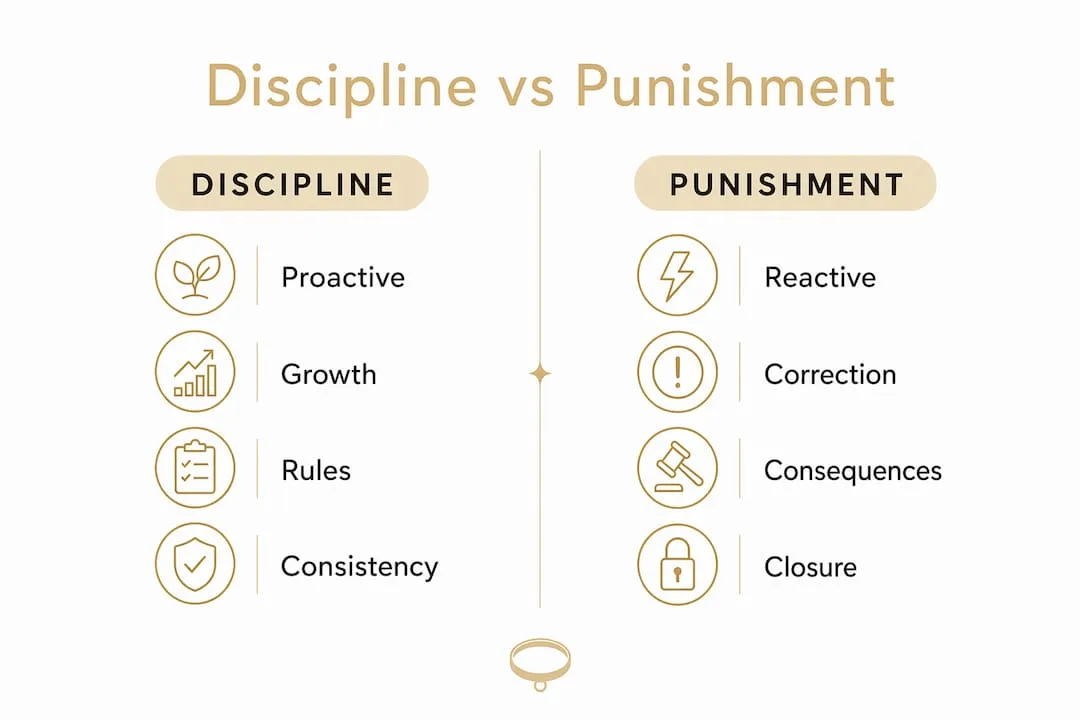
In BDSM, discipline is the ongoing structure of rules a dominant and submissive agree on, and punishment is the consequence when one of those rules is broken. People use the terms interchangeably all the time, but they do different jobs. Discipline is the proactive, structured framework a dominant and submissive build together: the rules, protocols, and behavioral expectations negotiated in advance to shape consistent behavior. Punishment is the reactive consequence applied when those agreed-upon rules are broken. One teaches. The other corrects.
Both require full, informed consent, a working safeword, and aftercare. Neither is optional on those points.
At a glance:
- Discipline sets expectations, builds habits, and guides growth through training and reinforcement
- Punishment addresses a specific breach, providing corrective closure and restoring accountability
- Both must be negotiated before any scene begins, with safewords honored without exception
- Confusing the two creates instability, resentment, and ineffective behavior management
What does BDSM discipline actually involve?
Discipline in BDSM is the practice of a dominant setting clear rules that a submissive is expected to follow, with the shared goal of shaping behavior over time. Think of it as the architecture of a power exchange relationship: the structure that defines what good behavior looks like before any mistake happens.

Discipline techniques range from formal protocols (standing a certain way, using specific honorifics, completing daily tasks) to behavioral reinforcement through rewards and corrections. Rules set core values and boundaries, while protocols define expected behaviors in specific contexts, often as if/then scenarios. A submissive might be required to ask permission before eating during a session, or to complete a written reflection every evening. These aren’t punishments. They’re training.
The psychological goal of discipline is growth, not correction. Consistent structure builds confidence in both partners, because everyone knows what is expected and what success looks like. Communication and regular check-ins are part of this, not afterthoughts.
Pro Tip: Set a small number of rules you can actually enforce consistently. Protocol without enforcement teaches the submissive that the rules don’t matter, which is worse than having no protocol at all.
What is BDSM punishment, and when does it apply?
Punishment is reactive by definition. It happens after a rule is broken or a task is failed, and its purpose is correction, closure, and the restoration of accountability within the dynamic. In other words, punishment is the consequence issued for misbehavior, distinct from the ongoing training that discipline provides.
Common punishment forms include physical consequences (such as spanking or bondage in an uncomfortable position), psychological consequences (such as verbal correction or temporary loss of privileges), and task-based consequences (writing lines, completing a specific act of service). The choice of punishment method should be negotiated in advance, not improvised in the moment. A submissive can even be given a say in selecting their consequence, which reinforces agency within the power exchange.
Punishment carries real emotional weight. Done well, it provides the submissive with a sense of closure and a clean slate. Done poorly, or without consent, it becomes something else entirely.
Pro Tip: Never apply punishment when you’re angry. The goal is correction and restoration, not venting. A calm, deliberate response lands far more effectively than a reactive one.
How discipline and punishment differ, and why mixing them up causes problems
The clearest way to frame this: discipline prevents mistakes, punishment addresses them. Discipline builds consistent habits through repetition and clear expectations, while punishment provides corrective closure when those habits slip.
When dominants skip the discipline framework and jump straight to punishment, the submissive has no stable foundation to work from. Arbitrary punishment without training breeds resentment and doesn’t lead to improvement. The submissive ends up confused about what is expected, and the dominant loses credibility as a consistent guide.
Here’s where the distinction gets psychologically meaningful:
- Discipline is ongoing. It operates every day, in every interaction governed by the dynamic.
- Punishment is episodic. It responds to a specific failure and then ends, restoring the relationship to its baseline.
- Mixing them (punishing as a default training tool, or using discipline as a threat) erodes trust and creates anxiety rather than stability.
- Balanced use of both, with clear communication about which is happening and why, builds the kind of trust that makes a power exchange dynamic genuinely fulfilling.
Discipline that combines corrective consequences with positive reinforcement tends to create more stable behavior, with less fear, than punishment alone. Rewarding a submissive for good behavior, such as extra privileges or verbal praise, is as much a part of the framework as any corrective measure.
Why consent, safewords, and aftercare are non-negotiable
The line between ethical BDSM and abuse is informed consent and negotiated limits, not the intensity of the activity itself. Every punishment method, every disciplinary protocol, must be agreed upon before the scene begins.
Safewords are the mechanism that makes dynamic consent real. Safeword use must be respected immediately, without punishment, retaliation, or pressure to continue. Punishing a submissive for using their safeword destroys the very tool that keeps the dynamic safe. Ethical discipline treats a safeword as a moment to stop and restore, not a negotiating point.
Key safety requirements for both discipline and punishment:
- Explicit prior consent for every activity, verbal or written, before the scene starts
- Safewords honored immediately and without exception, every single time
- Aftercare provided after any punishment or intense disciplinary session, physical and emotional support both
- No renegotiation mid-scene unless it is to remove a previously agreed activity
- Frameworks like SSC (Safe, Sane, Consensual) or RACK (Risk Aware Consensual Kink) provide ethical guardrails for structuring these agreements
Consent frameworks only work when both partners actively uphold them, not just agree to them in theory. A limit that is written down but ignored in the moment protects no one.
Aftercare is not optional after punishment. The emotional intensity of a corrective scene, even a consensual one, can leave a submissive feeling vulnerable, ashamed, or disconnected. Physical comfort, verbal reassurance, and time to decompress together are what close the loop and preserve the health of the dynamic.
What is funishment, and how is it different?
Funishment is the playful middle ground that doesn’t quite fit either category. It refers to enjoyable, punishment-themed activities that both partners actually want to happen, framed as consequences but functioning as play.
A submissive who “misbehaves” to earn a spanking they love is engaging in funishment, not genuine punishment. Funishment is defined as punishment framed as play, distinct from the corrective intent of real discipline or punishment. The difference matters for emotional safety: genuine punishment carries weight and consequence, while funishment is mutual entertainment.
Funishment fits naturally into BDSM dynamics as a way to play with power exchange without the emotional stakes of real correction. The key is that both partners are clear on which mode they’re in. Blurring that line, letting funishment substitute for real accountability, gradually hollows out the disciplinary framework.
Discipline and punishment with an AI Domina
Managing a discipline and punishment framework takes structure, consistency, and a reliable way to track expectations over time. Mistrix is a private, female-led AI companion for adults that combines an AI Domina with written guided sessions, tasks and routines, and a living memory of your dynamic.
Onboarding sets the foundation: a short experience quiz, a fetish map, hard limits and a safe word. Hard limits are applied as absolute restrictions to everything your Domina plans or writes, and the safe word button ends a session instantly, without penalty. From there, the AI Domina proposes personalized sessions covering submissive training, tasks, and scenes calibrated to your preferences and limits.
What makes Mistrix useful for discipline and punishment specifically:
- Session reviews and a level that move over time: at the end of each session she reviews how you did, and her verdict shapes your level on a 10-step scale and her mood
- Tasks and routines set around your preferences; skip one and she notices and reacts in character, with disappointment, a cooler tone or sometimes a consequence
- Safe word and limits enforcement built into every generation, so the consent framework is structural, not optional
- Private by design: your fetish map, hard limits, safe word and chats are encrypted on your device with a PIN-derived key, so the server stores only data it cannot read
- AI-generated images and scenes through the built-in studio, supporting immersive discipline and punishment scenarios
Explore AI Domina personalities on Mistrix to find a Domina whose style matches your dynamic (Premium also lets you create your own), whether you’re building a discipline framework from scratch or refining an existing one.
How to communicate expectations and boundaries clearly
Clear communication before any discipline or punishment begins is what separates a healthy dynamic from a harmful one. Both partners need to know exactly what behaviors are expected, what constitutes a rule violation, and what consequences apply to which infractions.
Start with a written agreement or BDSM contract that lists the rules, the protocols, and the corresponding punishments. This isn’t about bureaucracy. It’s about removing ambiguity so that neither partner is guessing when a correction is warranted. Protocol must be negotiated, not imposed: both partners should agree on the rules, understand their purpose, and feel comfortable with their scope.
Regular check-ins outside of scenes, sometimes called “vanilla time,” give both partners space to revisit what’s working and what isn’t. A rule that made sense at the start of a dynamic may need adjustment as the relationship evolves. Keeping those conversations open prevents resentment from building quietly beneath the surface.
How power exchange shapes the way discipline and punishment work
The dominant/submissive dynamic is the context that gives both discipline and punishment their meaning. Without a genuine power exchange agreement, discipline is just a list of rules and punishment is just harm. The exchange of authority is what transforms both into something consensual, purposeful, and often deeply fulfilling.
Dominants carry the responsibility of consistent enforcement. Inconsistent enforcement creates confusion and anxiety: if a dominant sets a rule and then ignores violations, the submissive learns that the rules don’t matter. That erosion of structure undermines the entire disciplinary framework. A dominant who cannot enforce a protocol should formally suspend it rather than let it decay.
Submissives, for their part, bring accountability to the dynamic by following through on agreed behaviors and being honest when they fall short. The power exchange only functions when both sides take their roles seriously. Discipline and punishment are tools within that exchange, not ends in themselves. The goal is always a dynamic where both partners feel secure, respected, and genuinely connected.
Key Takeaways
Discipline is the proactive framework that teaches behavior, while punishment is the reactive consequence for breaking agreed rules, and both require full consent, safewords, and aftercare to function ethically.
| Point | Details |
|---|---|
| Discipline vs punishment | Discipline sets behavioral expectations proactively; punishment corrects specific rule violations reactively. |
| Consent is foundational | Every punishment method and disciplinary protocol must be negotiated and agreed upon before any scene begins. |
| Safewords are non-negotiable | Safeword use must be respected immediately, without retaliation or pressure to continue. |
| Funishment is distinct | Funishment is playful, enjoyable “punishment” theater; it differs from genuine corrective punishment in intent and emotional weight. |
| Aftercare closes the loop | Physical and emotional aftercare after punishment preserves the health and trust of the dynamic. |
FAQ
What is the difference between discipline and punishment in BDSM?
Discipline is the proactive structure of rules and protocols that guides a submissive’s behavior, while punishment is the specific consequence applied when those rules are broken. One prevents mistakes; the other corrects them.
Is funishment the same as real BDSM punishment?
No. Funishment refers to playful, enjoyable “punishment”-themed activities that both partners want to happen, with no genuine corrective intent. Real punishment carries emotional weight and addresses an actual rule violation.
What are the main types of punishment used in BDSM?
BDSM punishment can be physical (spanking, bondage), psychological (verbal correction, loss of privileges), or task-based (writing lines, acts of service). All types must be negotiated and consented to in advance.
Does discipline in BDSM always involve punishment?
Not always. Discipline can include positive reinforcement, such as rewards for good behavior, and sometimes a firm look or tone from the dominant is enough. Punishment is one tool within discipline, not its only expression.
What makes BDSM discipline and punishment ethical?
The key boundary is informed consent and negotiated limits. Ethical practice requires explicit prior agreement, safewords honored without exception, and aftercare provided after every intense session.