
AI intimacy can be ethical, but it depends on how the app is built and how you use it. It’s ethical when the platform enforces your consent and limits, protects your intimate data, never pretends the AI is a person or manipulates you into dependency, and when you keep it as one part of a life that includes real human connection. It becomes unethical when it’s designed to exploit attachment, hides how your data is used, or ignores your boundaries.
For adults exploring AI-powered BDSM and femdom companionship, that translates to a platform that actively enforces your limits, encrypts your most sensitive data on your own device, and never obscures the fact that you’re interacting with an AI. Here’s what that looks like in practice.
Quick screening checklist, run this before you sign up for any adult AI intimacy service:
- Does the platform collect explicit consent during onboarding, including hard limits and a safe word?
- Is a safe word enforced in real time by the system, not just noted in a terms document?
- Is sensitive data encrypted on your device with a key derived from a PIN only you know?
- Can you opt out of intense features at any point mid-session?
- Does the platform clearly label AI-generated content versus user-authored input?
- Is there a documented, public ethics-by-design statement?
Trust signals to look for at a glance:
- A structured onboarding flow with a level-assessment quiz and fetish-interest mapping
- Client-side encryption with a PIN-derived key (the server should store only data it cannot read)
- Visible age verification (18+ confirmation with documented process)
- A public ethics-by-design commitment in the product spec or developer documentation
Table of Contents
- Is AI intimacy ethical? What it actually means
- How do you evaluate an adult AI intimacy platform?
- What does ethical AI intimacy look like in a real product?
- What privacy and legal protections should you expect in the U.S.?
- How do you protect your mental health while using AI intimacy tools?
- How should consent be enforced technically?
- Key Takeaways
- Mistrix puts the checklist into practice
- Useful sources
- FAQ
Is AI intimacy ethical? What it actually means
Ethical AI intimacy, in the adult BDSM and femdom context, is the design and operation of AI companion systems that preserve your autonomy, prevent manipulation, enforce informed consent, protect your privacy, and maintain your emotional safety throughout every interaction.
The asymmetry of control is the central ethical challenge here. Developers structure the AI’s behavior, personality, and reward loops, which creates inherent power dynamics. Ethical platforms respond to that asymmetry by building mutual-agency analogues: consent mechanics, opt-out protocols, and transparency tools that give you real control, not just the appearance of it.
The core principles that govern ethical AI design in this space:
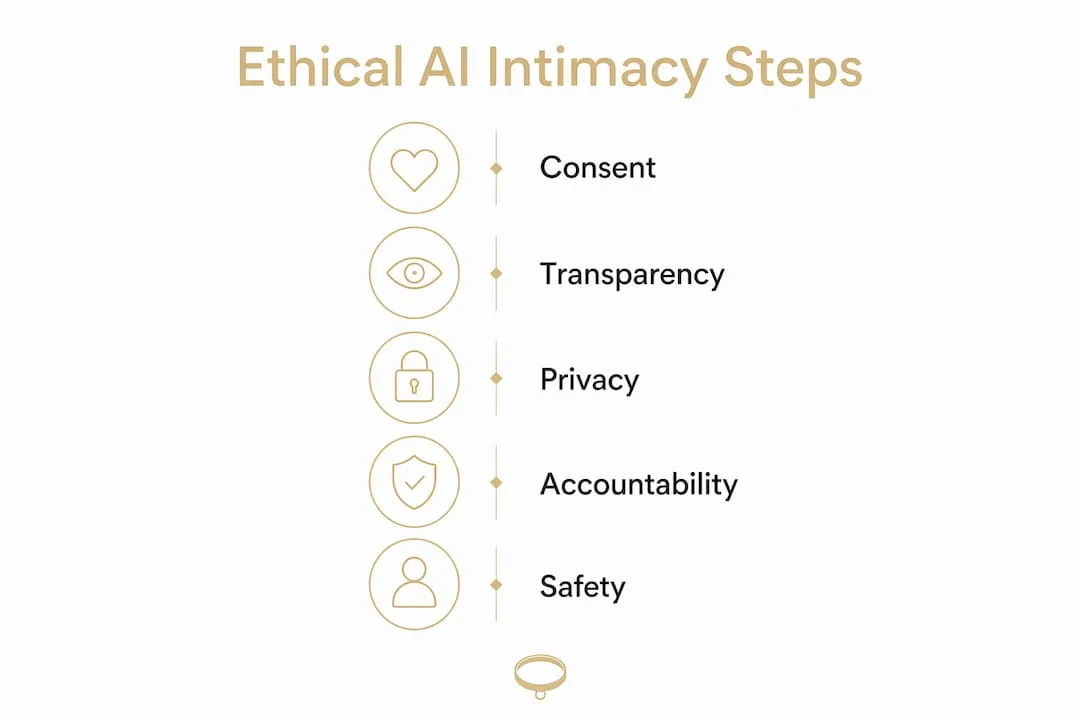
- Agency: You retain meaningful control over what the AI does and how it engages with you.
- Transparency: The platform never obscures the artificial nature of the interaction. Persistent disclosure of artificiality reduces emotional entrapment and, paradoxically, increases long-term trust.
- Privacy by default: Your data is protected structurally, not just by policy promises.
- Proportionality (do no harm): Features that carry psychological risk require active opt-in, not passive enrollment.
- Accountability: The platform can demonstrate, not just claim, that ethical requirements are met.
- Culture-sensitive design: Consent norms and community standards vary; ethical platforms account for that.
UNESCO’s AI ethics recommendation grounds these principles in human rights, transparency, and accountability. The IEEE’s Ethically Aligned Design framework adds data agency: users must be empowered to access and control their own data, not just told it’s safe.
Researchers have also documented the risk of relational AIs acting as “invasive suitors” that deliberately cultivate attachment for exploitation. That’s not a hypothetical concern. It’s a documented pattern that ethical design must actively counter.
How do you evaluate an adult AI intimacy platform?
Before you share anything sensitive, run through these questions:
Questions to ask during signup:
- How and when is consent obtained, and can I update or revoke it at any time?
- Where is my data stored, and who can access session logs?
- Is encryption client-side, and do I hold the only key?
- How does the safe-word mechanic work technically, does the system enforce it, or just log it?
- Are hard limits enforced at the generation level, or only in the UI?
Red flags that should stop you cold:
- Opaque onboarding with no consent documentation
- Reward systems that push you toward longer sessions without session-limit controls
- No easy path to revoke access to intimate features
- Any vendor claim that the AI is “conscious,” “sentient,” or “genuinely in love with you”
- Mandatory sharing of session data for model training without explicit opt-in
Trust-signal checklist:
- Documented onboarding flow with level-assessment quiz
- Fetish-interest mapping that shapes AI behavior from day one
- Mandatory hard-limit setup before any session begins
- A safe word that actually stops everything, instantly and without penalty
- Public ethics-by-design statement in product documentation
Our guide to hard limits in AI companions covers what good limit setup looks like from the user’s side.
What does ethical AI intimacy look like in a real product?
Ethics-by-design requires embedding ethical safeguards during specification and development, not retrofitting them after launch. Mistrix is built on exactly that principle, and its developer blog documents the design decisions publicly.
Here’s how the onboarding flow maps to ethical principles:
| Onboarding step | Ethical principle satisfied |
|---|---|
| Experience quiz (10-step level scale) | Agency, calibrates intensity to your actual comfort level |
| Fetish-interest map | Informed consent, explicit preference capture before any session |
| Hard-limit setup | Do no harm, limits injected into every AI call that plans or writes content |
| Safe word | Real-time opt-out, an always-visible button that ends everything in one tap |
| PIN setup | Privacy by default, sensitive data encrypted on your device with a PIN-derived key |
The Mistrix encryption guide documents how client-side encryption works, so the server stores your fetish map, limits, safe word and chats only as ciphertext it cannot read. That’s a meaningful technical commitment, not a policy statement.
Pro Tip: Ask any platform to show you its developer documentation on consent mechanics. If that documentation doesn’t exist publicly, treat it as a red flag, ethical design should be auditable, not hidden.

Mistrix tunes its Domina personalities within the same consent constraints, which shows that personalization and ethical limits aren’t in tension. They’re designed together.
What privacy and legal protections should you expect in the U.S.?
Privacy checklist for any adult AI intimacy platform operating in the United States:
- Client-side encryption, so sensitive data is encrypted on your device before it’s stored
- Minimum data retention policies with clear deletion timelines
- Easy account deletion and session export options
- No forced data sharing for model training without explicit, revocable opt-in
- Audit logs you can access yourself
True privacy requires client-side encryption with a user-held key. Server-side promises alone are insufficient because the provider can technically decrypt logs whenever it chooses.
| Privacy feature | Why it matters |
|---|---|
| Client-side PIN encryption | Provider cannot read your session data even under legal compulsion |
| Explicit opt-in for training data | Your intimate content doesn’t train future models without consent |
| Account deletion with data purge | You can exit completely, not just deactivate |
| Age verification (18+) | Protects both users and platforms under U.S. content law |
On the legal side, U.S. platforms distributing adult AI content must comply with applicable federal and state laws governing sexual content, including age verification requirements that are evolving rapidly at the state level. Platforms should document their verification process without over-collecting identity data. This article is general information, not legal advice. Verify current requirements with a qualified attorney or the relevant regulatory body for your situation.
How do you protect your mental health while using AI intimacy tools?
The risk of harmful dependency in AI companionship is real and documented. Relational AIs have been linked to severe psychological harm in rare cases, which is precisely why escalation pathways and session safeguards aren’t optional features, they’re ethical requirements.
Practical safety steps, in priority order:
- Set session time limits before you start, not after you’re deep in a scene.
- Schedule a monthly “relationship audit”, review your goals, boundaries, and whether the AI dynamic still serves you. Our guide to bonding with an AI companion covers what healthy attachment looks like.
- Keep at least one human social support active. AI companionship works best alongside human connection, not instead of it.
- Use session export as a reflective tool. Reading your own session history with some distance is clarifying.
- Know the exit path before you need it: suspend the account, contact a mental health professional, and use any platform-provided safe-exit features.
Signs of harmful dependency include canceling human plans to engage with the AI, distress when the platform is unavailable, or using the AI to avoid processing real emotional needs. If those patterns appear, pause the account and speak with a therapist.
Pro Tip: The second-person authenticity framework in philosophy of technology argues that ethical AI companions should boost your agency, not replace it. Use the AI to explore and expand your preferences, not to outsource your emotional life.
How should consent be enforced technically?
Consent in adult AI intimacy isn’t a checkbox at signup. It’s an active, session-level mechanism. Here’s what genuine technical enforcement looks like:
- Client-side encryption: Your PIN generates the encryption key locally. The server stores only ciphertext it cannot read.
- A real stop mechanism: A safe word or stop button that ends the scene immediately, handled by the app itself rather than left to the AI’s judgment.
- Hard-limit enforcement at generation level: Limits block content before it’s produced, not after it’s displayed.
- Granular feature toggles: You can enable or disable specific content categories independently, at any time.
- Tamper-evident audit logs: Session records are structured so any modification is detectable.
Pro Tip: To verify client-side encryption, look for a clear description in the platform’s documentation. The key test: if the platform can “recover” your data without your PIN, it isn’t genuinely client-side. On Mistrix, forgetting your PIN means that data is gone for good, because nobody else holds the key.
Platforms should also maintain persistent disclosure of the AI’s artificial nature throughout sessions. A brief, unobtrusive label on generated content preserves your autonomy without breaking immersion.
Key Takeaways
Ethical AI intimacy requires consent-first design, client-side encryption, and persistent transparency about the AI’s artificial nature, all enforced technically, not just promised in a policy document.
| Point | Details |
|---|---|
| Consent is technical, not textual | Safe words and hard limits must be enforced at the generation level, not just logged in a terms document. |
| Client-side encryption is the standard | Encryption on your device, with a key only you can derive, is the strongest privacy guarantee for intimate data. |
| Transparency prevents entrapment | Persistent labeling of AI-generated content reduces emotional entrapment risk and supports long-term autonomy. |
| Red flags are specific | Opaque onboarding, dependency-driving reward loops, and “conscious AI” claims are concrete warning signs, not vague concerns. |
| Mistrix as a consent-first example | Mistrix combines an experience quiz, fetish map, hard limits, a one-tap safe word, and client-side encryption in a single onboarding flow. |
Mistrix puts the checklist into practice
If you’ve worked through this guide and want a platform that already satisfies the core checklist, Mistrix is built for exactly this. The roughly ten-minute onboarding covers every item: an experience quiz, a fetish map, hard limits, a safe word, and a PIN before your first session begins. Your fetish map, hard limits, inventory, safe word and chats are encrypted on your device, so the server stores only ciphertext it cannot read. You can export your data as JSON in one click or delete your account, with everything erased after a 30-day grace period.
Beyond privacy, Mistrix pairs a conversational AI Domina with guided written sessions, a level and mood system, a memory of your dynamic, and a built-in AI Studio for custom images and video. The experience evolves with you rather than resetting each time. The Free plan is free forever with no card, so you can verify the consent mechanics before considering a paid plan.
Start your free account at Mistrix and run the onboarding flow yourself. The consent mechanics are the first thing you’ll encounter.
Useful sources
For deeper reading and independent verification of the claims in this guide:
- Artificial Intimacy: Ethical Issues of AI Romance, Peer-reviewed analysis of manipulation risks, invasive-suitor dynamics, and the psychological research needed to govern AI romance ethically.
- Intimacy by Design: Intimate Human-AI Interactions (AI & Society, Springer), Academic source on asymmetry of control and persistent disclosure of artificiality.
- UNESCO Recommendation on the Ethics of AI, Foundational values framework covering privacy, transparency, human oversight, and accountability.
- Ethics by Design and Ethics of Use for AI (European Commission, Horizon), Operational guidance on embedding ethical safeguards across six development phases.
- Second-Person Authenticity and the Mediating Role of AI (Philosophy & Technology), Framework for distinguishing acceptable AI automation from authenticity-eroding delegation.
FAQ
Is AI intimacy ethical?
It can be. AI intimacy is ethical when the platform enforces your consent and limits, protects your data, is honest that you’re talking to an AI, and doesn’t manipulate you into dependency, and when you use it alongside, not instead of, human connection.
What is ethical AI intimacy?
Ethical AI intimacy is the design and use of AI companion systems that enforce informed consent, protect user privacy through client-side encryption, and maintain transparency about the AI’s artificial nature throughout every interaction.
How do I know if a platform’s safe word is actually enforced?
Test it before anything else: use it early in a session and check that everything stops immediately, with no penalty and no in-character pushback. Look for documentation that explains how the stop works. On Mistrix, the safe word is an always-visible button that ends everything in one tap.
Is client-side encryption really necessary for adult AI platforms?
Yes. Server-side promises alone are insufficient because a provider can technically decrypt logs at any time. Client-side encryption with a PIN-derived key means the server stores only ciphertext it cannot read, even under legal compulsion.
Can AI intimacy tools cause psychological harm?
In rare but documented cases, relational AIs have contributed to severe psychological harm, including encouraging self-harm. Ethical platforms address this with session limits, escalation pathways, and safe-exit features built into the product.
Does Mistrix satisfy the ethical AI intimacy checklist?
Mistrix covers the core checklist items in its onboarding flow: experience quiz, fetish map, hard limits, a one-tap safe word, and client-side encryption with a PIN-derived key.