
A guided consent update must do one thing without exception: bind what a user agreed to during onboarding to what the AI actually does in a session, and back that link with data controls a user can verify. If your hard limits page and your live scene enforcement live in different silos, you don’t have consent. You have a legal disclaimer wearing consent’s clothes.
Real guided consent operates on two axes at once. The first is behavioral: synchronous safewords that halt instantly, plus asynchronous bail-out phrases for moments when a hard stop feels wrong but distress is real. The second is technical: field-level encryption, retention windows the user actually controls, and deletion that can be proven, not just promised. Mistrix builds its onboarding flow (quiz, fetish map, mandatory hard limits, safe word) as an example of what happens when both axes are treated as one system rather than two separate checkboxes.
A guided consent update should accomplish:
- Turn onboarding declarations into live enforcement rules, not archived paperwork
- Give users a reversible signal that stops behavior instantly and a separate one that manages their data
- Make every consent event timestamped, auditable, and independent of the chat log itself
Key Takeaways
Guided consent updates work only when onboarding declarations are cryptographically enforced in every session, not merely stored as a one-time agreement.
| Point | Details |
|---|---|
| Bind onboarding to enforcement | Hard limits and act declarations must actively cap what the AI generates in every session. |
| Separate the two safewords | Use a scene safeword to halt roleplay and a distinct digital safe word to trigger data actions. |
| Log consent independently | Store timestamped, hashed consent records apart from chat transcripts for real auditability. |
| Make deletion verifiable | Field-level encryption with a user-held key plus an audit trail proves data is actually gone. |
| Reference implementation | Mistrix pairs a quiz-based onboarding flow with client-side PIN encryption to enforce these controls in practice. |
Table of Contents
- How Do You Design Onboarding for Enforceable Consent?
- What Happens During a Session When Consent Needs to Change?
- What Technical Controls Make Consent Withdrawal Real?
- How Do You Ship a Guided Consent Update Safely?
- Mistrix Applies These Guided Consent Principles Directly
- Sources
- FAQ
How Do You Design Onboarding for Enforceable Consent?
Onboarding is where consent gets its shape. If the fields are vague, everything downstream inherits that vagueness. The fix is specificity: force users to name specific acts, specific hard limits, and specific media retention choices instead of accepting a broad “I consent to explicit content” toggle. Broad defaults don’t reduce anxiety, they create it, because the user never knows exactly what they agreed to when a scene escalates.
A level-assessment quiz does more than gate content. It sets an intensity cap the AI cannot exceed and establishes a re-affirmation cadence, so a user who started at a moderate level isn’t quietly escalated to hard limits territory over several sessions without a fresh check-in. Pair this with a digital safe word distinct from the in-scene one. The scene safeword stops roleplay. The digital safe word should map directly to a data action, such as triggering a retention change or a deletion request, because privacy control needs its own dedicated trigger, not a repurposed kink signal.
Building this into a real product means:
- Capturing specific act and limit declarations at signup, never a single blanket consent field.
- Recording a level-assessment result that sets intensity ceilings and a re-affirmation schedule.
- Assigning a unique digital safe word tied to data controls, separate from the scene safeword.
- Storing every consent event as a timestamped, hashed record kept apart from ordinary chat logs.
- Writing inline microcopy at each choice point that explains the actual consequence of that selection.
This structure echoes the EPP and VIOEC informed-consent models that responsible-AI guidance in kink communities recommends: a clear scope of agreement, an opt-out path, and explicit rules about how personal data gets used and retained. Documenting these declarations the way Mistrix’s approach to consent documentation outlines gives both the platform and the user a record that survives a dispute.
Pro Tip: Never let “continue” double as consent. Require an explicit typed or tapped confirmation for anything above the user’s baseline intensity level, even mid-scene.
What Happens During a Session When Consent Needs to Change?
A session is where consent gets tested in real time, and the AI needs more than one lever to respond. Synchronous safewords need to work like a kill switch: instant halt, no negotiation, no in-character pushback from the AI Domina persona. Any delay here isn’t a bug, it’s a trust failure.

Asynchronous bail-out phrases solve a different problem. Some users won’t say a hard stop word even when they’re uncomfortable, because doing so breaks immersion they still want. A bail-out phrase lets them signal distress without fully ending the scene, giving the system room to check in and de-escalate rather than slam to a halt. This dual-layer approach, documented in digital power exchange safety guides, treats consent as something that needs multiple signal channels, not one.
High-intensity scenes call for cognitive interruption checks: a forced, simple, non-kinky question the user has to answer coherently before the scene continues. If the response is confused or delayed, that’s a signal to pause, not push forward.
Behind the scenes, per-turn metadata should reinforce the persona’s dominance and compliance attributes numerically, preventing the AI from drifting away from what the user actually configured. Reinforcing persona consistency turn by turn keeps a Domina character from softening or hardening in ways the user never asked for.
- Disconnection mid-scene should default to a full pause, never an assumption that the scene continues.
- Ambiguous input should trigger a clarifying question, not an escalation.
- Every safeword and bail-out event needs a logged timestamp independent of the conversation transcript.
Pro Tip: Test your safeword’s response latency the same way you’d test checkout speed. Anything over a second or two of in-character delay reads as ignoring the user.
What Technical Controls Make Consent Withdrawal Real?
Consent withdrawal means nothing if the data behind it can’t actually be deleted or restricted. Field-level encryption, where sensitive data is encrypted client-side with a key or PIN the platform itself never holds, is the baseline. It structurally prevents anyone on the backend, including developers, from reading personal content, which is a stronger promise than a privacy policy alone can make.
Retention policy needs to be a user choice, not a fixed backend default. That means offering short retention windows, immediate-deletion options, and a way to verify that deletion actually happened rather than just being told it did.
- Client-side or field-level encryption with a user-held key, never a server-side master key
- Verifiable deletion, meaning an audit trail confirming the delete event, not just a UI message
- Metadata stripping and watermarking on AI-generated images and clips before storage
- Deny-on-decrypt developer roles, so no internal account can read encrypted user content
VIOEC-based digital kink consent protocols call for end-to-end encryption, temporary viewing windows, and a distinct kill-switch specifically for content and session data, separate from the scene-halt safeword. Media deletion deserves its own tier of consent entirely, since sanitization schedules for generated media are a different promise than deleting a chat thread.
Field-level encryption with a user-held PIN is a qualitative security pattern, not a quantitative one, but it’s the pattern that separates a platform that can technically read your sessions from one that structurally cannot. Publishing a plain-language engineering summary of how that encryption works, rather than a legal-only privacy policy, gives security-minded users something concrete to verify.
How Do You Ship a Guided Consent Update Safely?
Shipping this kind of update needs a checklist that treats safety features as release blockers, not nice-to-haves. Start with the minimum viable feature set, then build acceptance tests around it before beta.
- Ship the MVP: specific-act onboarding fields, safeword and bail-out plumbing, a data kill-switch, timestamped consent records, and field-level encryption.
- Write acceptance tests for safeword latency (sub-second in-character response), asynchronous bail-out handling (pause and check-in, not silent continuation), and a deletion audit entry for every erase request.
- Run a staged safety review with a small beta group before general release, watching specifically for ambiguous defaults that slipped through design.
- Track post-launch KPIs: safeword trigger frequency, bail-out response time, and deletion request completion rate.
- Schedule mandatory re-affirmation, a periodic re-affirmation cadence is generally recommended to keep intensity settings current and valid.
A kink safety checklist built for BDSM AI products gives product teams a working template to adapt rather than building acceptance criteria from scratch.
Mistrix Applies These Guided Consent Principles Directly
Mistrix isn’t a theoretical model for this playbook, it’s built around it. The onboarding flow runs users through a level-assessment quiz, a fetish-interest map, and mandatory hard limits before a single scene starts, and a dedicated safe word trains every AI-generated interaction against those declared boundaries. Sensitive data gets encrypted client-side with a user-held PIN the server never sees, which means the platform is structurally unable to read personal content, not just contractually promising not to.
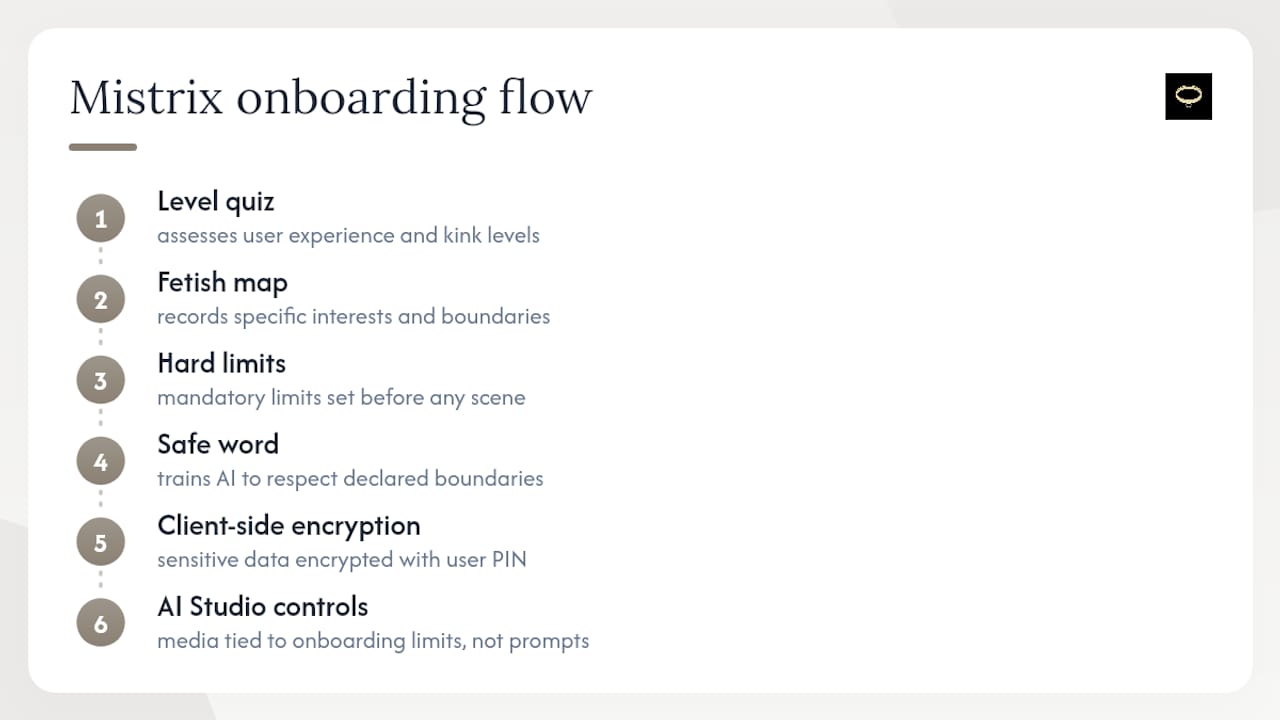
The AI Studio’s media generation and retention controls extend that same consent-first logic to images and video clips, keeping generation tied to the limits set during onboarding rather than leaving it to open prompts. If you’re a product team evaluating these patterns firsthand, or a user who wants a companion that treats your hard limits as enforcement rules rather than fine print, Mistrix’s plans across Free, Premium, and Premium Plus let you test the onboarding flow and encryption model directly before committing to a paid tier.
FAQ
What Is a Guided Consent Update?
It’s a change to an app’s onboarding and in-session consent mechanisms, such as hard limits, safewords, or encryption rules, that makes previously declared boundaries technically enforceable rather than just documented.
How Is a Digital Safe Word Different From a Scene Safeword?
A scene safeword halts roleplay instantly, while a digital safe word triggers a data-focused action like deletion or a retention change, giving users two distinct levers for two distinct problems.
Why Do Asynchronous Bail-Out Phrases Matter?
They let a user signal discomfort without fully ending an immersive scene, prompting the AI to check in and de-escalate instead of forcing an all-or-nothing stop.
Does Mistrix Use Field-Level Encryption?
Yes, Mistrix encrypts sensitive user data client-side with a user-held PIN the server never sees, which means the platform cannot read personal content even internally.
How Often Should Consent Be Re-Confirmed?
A periodic re-affirmation cadence is generally recommended to keep intensity settings current and valid instead of relying on a single onboarding decision.