
A BDSM contract is a written record of what partners agreed during negotiation: hard and soft limits, safewords, health disclosures, aftercare and when the agreement will be reviewed. It is generally not legally binding, and consent can be withdrawn at any moment, so its value is clarity and shared memory rather than enforcement.
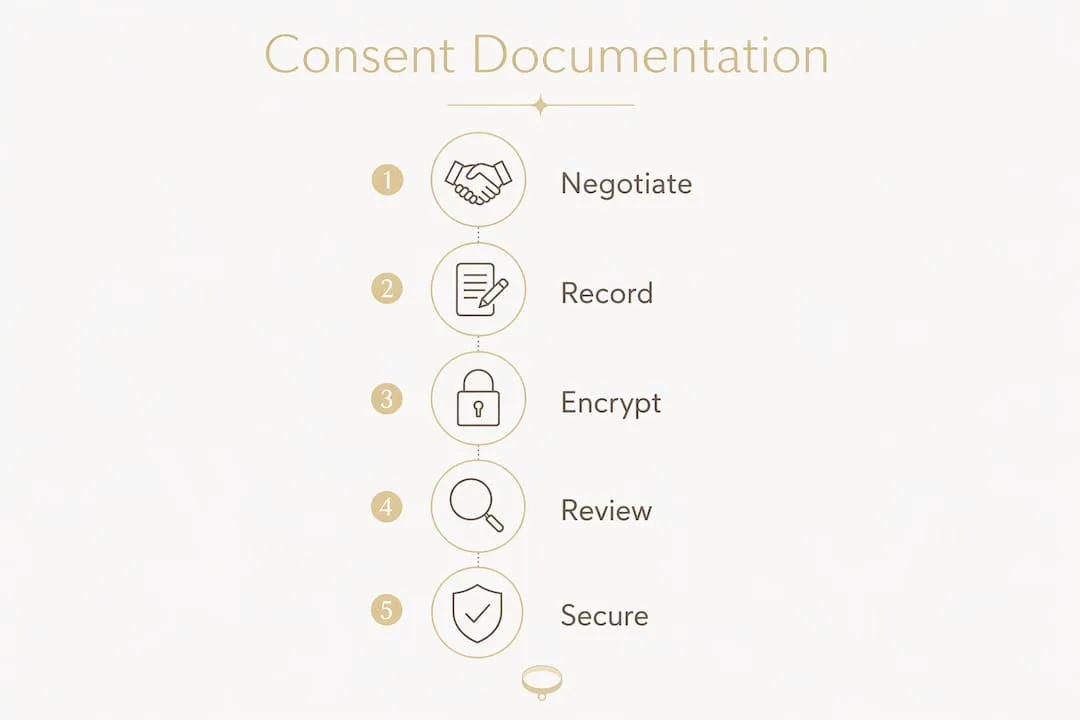
Writing a BDSM contract means creating a clear, living record that names all parties, separates hard limits from soft limits and health disclosures, records safewords plus non-verbal stop signals, defines aftercare expectations, and sets a review cadence. Then you store that record with privacy-first controls. The written document is a record of a real conversation, not a substitute for one. As Playful Mag notes, the contract should capture outcomes of negotiation, never be the first place partners discover each other’s desires.
Every solid consent record covers these elements:
- Parties: scene names and, optionally, legal names
- Scope: single scene, recurring sessions, or ongoing dynamic with effective dates
- Limits: hard limits (non-negotiable), soft limits, and health disclosures
- Safewords and non-verbal signals: verbal code plus a physical stop signal
- Practices and implements: named specifically, with intensity levels
- Aftercare: mutual expectations, immediate and 24-hour follow-up
- Review cadence and revocation procedure
- Privacy controls: who can access the record and how it is encrypted
If you are still working out what goes on the list, fill in a yes no maybe list first and use the contract to record the outcome.
Table of Contents
- What goes in a BDSM contract?
- How to write each section of a BDSM contract
- Is a BDSM contract legally binding, and how should you store it?
- Which digital tools help you document consent safely?
- What does a good aftercare and review process look like?
- BDSM contract template with two example entries
- How to introduce a BDSM contract before a scene
- Key Takeaways
- Practicing negotiation with an AI Domina
- Useful sources
- FAQ
What goes in a BDSM contract?
Think of this as your pre-scene checklist. Before any play begins, verify the document covers every field below.
- Who: scene names for all participants; emergency contact if the scene is in person
- When and scope: single scene or ongoing dynamic; effective date and scheduled review date
- Hard limits: absolute stops, non-negotiable by definition; list each one explicitly (see our hard limits list for examples)
- Soft limits: activities requiring prior discussion or a trial scene before proceeding
- Health disclosures: medications, conditions, allergies, failing to include these is one of the most common and dangerous oversights
- Safewords and non-verbal signals: traffic-light system (green/yellow/red) plus at least one physical signal for when speech is impossible
- Practices and implements: named specifically (paddle, flogger, cane), not just “impact play”
- Aftercare: what each partner needs and who provides it
- Revocation clause: how consent is withdrawn and how that withdrawal is recorded
- Storage note: who can access the file and what encryption protects it
Pro Tip: Draft the document together in real time during negotiation, not afterward from memory. Filling it out side by side surfaces gaps neither partner noticed in conversation.
How to write each section of a BDSM contract
Structure matters. Vague language creates risk; specific language creates safety.

| Section | What to record | Example entry |
|---|---|---|
| Header | Scene/legal names, document date, version number, scope | “Version 2, 1 March, ongoing D/s dynamic” |
| Hard limits | Physical, emotional, health, three labeled columns | Physical: no breath play. Health: beta-blocker medication on file. |
| Soft limits | Activities allowed under specific conditions | “Wax play, only with prior warm-up; discuss intensity before each use” |
| Safewords | Verbal code + non-verbal emergency signal | Red = full stop. Two taps on thigh = pause immediately. |
| Practices & implements | Named tools, intensity range, banned implements | “Leather paddle (light to moderate); no canes” |
| Aftercare | Immediate needs, 24-hour follow-up, who is responsible | “Blanket, water, brief debrief; text check-in next morning” |
| Review/renewal | Cadence and amendment process | “Quarterly review; changes require written amendment signed by both” |
| Termination | How either party ends the agreement | “Either party may revoke in writing or verbally; record date and time” |
The traffic-light safeword system is durable and widely understood (more options in our safe word ideas). Add a non-verbal signal for situations where speech is impossible, such as a double tap or dropping a held object.
For health disclosures, treat that column like sensitive medical data. Name the condition or medication, note any contraindications for specific activities, and restrict access to that field to the parties involved only.
Is a BDSM contract legally binding, and how should you store it?
Privacy is not optional when documents contain health disclosures and personal limits.
- Encrypted local file: a password-protected PDF or encrypted folder on your device; no cloud exposure
- Client-side encrypted cloud storage: the encryption key stays with you, not the provider
- Access control: only the parties named in the document should be able to read or edit it; log every version with a date
- Retention policy: decide upfront how long you keep records and how you permanently delete exports
- Digital hygiene: unique passwords, two-factor authentication on any cloud account, no unencrypted screenshots
One critical legal point: BDSM contracts are not legally enforceable in U.S. jurisdictions. Consent is revocable at any time, and documentation does not override criminal law. The document’s value is clarity and communication, not legal protection.
This article is general information, not legal advice. Confirm current laws with a qualified attorney for your specific situation.
Which digital tools help you document consent safely?
Not every app is built for this. Here is what to look for and how Mistrix maps to each requirement.
| Feature to require | Why it matters | Mistrix implementation |
|---|---|---|
| Client-side encryption | Server cannot read your data | Fetish map, hard limits and safe word encrypted on your device with a PIN-derived key |
| Hard-limit fields | Prevents skipping critical consent steps | Set during onboarding, applied to everything the AI plans or writes |
| Safeword | Stops a session instantly | Always-visible safe word button, one tap ends everything |
| Session export (PDF) | Creates a dated record of a session | Available on Premium Plus |
| Version history | Tracks amendments over time | Not built in; keep dated versions of your own document |
| Review reminders | Keeps the document current | Not built in; use a calendar reminder |
When you use an AI companion for negotiation, save the transcript, redact any personally identifying information before exporting, and timestamp the signed version. Store the export in an encrypted location, not in an unprotected downloads folder.
What does a good aftercare and review process look like?
Aftercare and review are where consent stays alive between scenes.
- Immediate aftercare (within the scene): physical stabilization first, then hydration, wound checks if applicable, and a brief emotional debrief. Decide in advance who speaks first and through what channel.
- Mutual aftercare: document what each partner needs and what they commit to provide. Both partners can need care, not just the submissive. Include a contingency if one partner needs space rather than contact.
- 24-hour check-in: a brief status message, note any unexpected reactions, and flag anything for renegotiation.
- Quarterly review (new dynamics): sit down together, read the document, and propose any amendments in writing. Move to semiannual once the dynamic is stable.
- Revocation log: if consent is withdrawn, record the date, time, and any immediate safety steps taken. Keep a time-stamped audit trail in a secure location.
A scheduled review cadence prevents the document from becoming decorative. A contract that no one revisits gives a false sense of security.
BDSM contract template with two example entries
Use the structure below as your starting point. Copy it into a secure document and fill in each field.
| Field | Single-scene example | Ongoing dynamic example |
|---|---|---|
| Parties | Scene names; date; “single scene” | Scene names; date; “ongoing D/s dynamic” |
| Hard limits | “No breath play. No marks above collar line.” | “No blood play. No public humiliation outside agreed spaces.” |
| Health disclosures | “Asthma, no smoke or aerosols” | “Anxiety disorder; avoid prolonged isolation scenes” |
| Safewords | Red = stop. Two taps = pause. | Red = stop. Drop the ball = full stop. |
| Implements | “Leather paddle (light); no canes, no clamps” | “Flogger (light to moderate); cane added by written amendment only” |
| Aftercare | “Blanket, water, brief debrief” | “Blanket, water, cuddle; text check-in next evening” |
| Review | N/A (single scene) | “Quarterly review; amendments in writing” |
How to introduce a BDSM contract before a scene
Bring the document into the conversation early, not at the last minute.
Pre-negotiate verbally first. Then fill the document together, field by field. Sign and export the signed copy before play begins. Immediately before the scene, confirm safewords and non-verbal signals out loud.
If a partner gives a vague answer to any field, treat it as a soft limit requiring a follow-up conversation or a short trial scene with documented conditions. Never push past ambiguity.
Pro Tip: If a conflict arises mid-scene, pause immediately, switch to aftercare mode, and schedule a separate renegotiation meeting. Hard limits are never renegotiated in the moment.
Contracts are not one-and-done. Schedule reviews, and see our guide to ongoing consent in BDSM for how to renegotiate limits as the dynamic changes.
Key Takeaways
Documenting BDSM consent means recording the full negotiation in a structured, versioned document with hard limits, safewords, health disclosures, mutual aftercare, and a scheduled review cadence, stored with client-side encryption.
| Point | Details |
|---|---|
| Document the conversation | The written record captures negotiation outcomes; it never replaces the conversation itself. |
| Separate all three limit types | Label hard limits, soft limits, and health disclosures in distinct fields, never combine them. |
| Make aftercare mutual | Both partners document what they need and what they commit to provide, including a 24-hour check-in. |
| Use privacy-first storage | Client-side encryption and user-held PINs keep health disclosures and limits out of server reach. |
| It is not legally binding | Consent stays revocable at any time; the contract records agreements, it does not enforce them. |
Practicing negotiation with an AI Domina
If you want to practice naming limits before writing them down with a partner, Mistrix offers a private place to do it. Onboarding takes about ten minutes and includes a fetish map, your hard limits and a safe word. Those are encrypted on your device with a key derived from your PIN, so the server stores only ciphertext it cannot read. Hard limits are applied as absolute restrictions to every session, task and scene, and the safe word button ends everything with one tap.
The free tier covers the full onboarding and one session a day. Premium Plus adds a session PDF export if you want a dated record of a session, and Premium lets you build your own AI Domina. A contract with a human partner is still a conversation between the two of you; the app is a place to rehearse it.
Useful sources
- BDSM Contract: Template and Guide, Cuffplay: primary reference for limits taxonomy, safeword structure, versioning, and specificity guidance
- BDSM Contract, BDSM Authority: hard limits definition, non-verbal signals, and consent violation framing
- How to Write a BDSM Contract, Playful Mag: negotiation-first framing and first-scene guidance
- BDSM Consent Form, Contract, and Checklist, WhatsBDSM: health disclosure requirements and checklist structure
- BDSM Contract, KinK Academy: legal non-enforceability and contract field overview
Recommended reading order: Start with Cuffplay for contract structure and field-level specificity, then BDSM Authority for hard limits and non-verbal signals, then Playful Mag for negotiation process and tone.
FAQ
What must a BDSM consent document always include?
At minimum: parties, scope, hard limits, soft limits, health disclosures, safewords with a non-verbal signal, practices and implements, aftercare expectations, and a revocation clause. Health disclosures are the most commonly skipped field and one of the most important.
Are BDSM contracts legally binding in the U.S.?
No. BDSM contracts are not legally enforceable in U.S. jurisdictions. Consent is revocable at any time, and a signed document does not override criminal law.
How often should you review a BDSM consent record?
Quarterly for new dynamics, moving to semiannual or annual once the relationship is stable. Every amendment should be dated and signed by both parties.
How does Mistrix help with documenting consent?
Mistrix asks for hard limits, a safe word and a fetish map during onboarding, then encrypts that data on your device with a PIN-derived key. Premium Plus members can export session PDFs as a dated record.
What is the difference between a hard limit and a soft limit?
A hard limit is absolute and non-negotiable; crossing it is a consent violation regardless of intent. A soft limit is an activity that may be explored under specific conditions, with prior discussion and explicit agreement each time.