
Good safe word ideas are short, easy to say under stress and impossible to mistake for scene dialogue: the traffic-light set (red to stop, yellow to slow down, green to continue) or a single out-of-context word like “pineapple,” “mercy” or “banana.” A safe word is a prearranged signal that ends or pauses play immediately, so the best one is simply the word both partners will recognize and respect without hesitation.
Before any play, run through this checklist:
- Pick your system. Traffic-light, one word, or a two-level pair.
- Define exact meanings. “Red” means full stop, not pause.
- Set a nonverbal backup. Three taps, a dropped object, or a hand squeeze.
- Agree to respect it instantly. No questions, no negotiating in the moment.
Three instant picks to get you started:
- Traffic-light (red/yellow/green): The most recognized system in the BDSM community, works without explanation for most partners.
- Pineapple: Silly, multi-syllabic, and nearly impossible to say by accident, a community favorite for good reason.
- Mercy: Serious, emotionally clear, and easy to say even under stress.
Key Takeaways
A safeword only works when both partners agree on its meaning, test it before play, and commit to an immediate response the moment it’s used.
| Point | Details |
|---|---|
| Pick a system first | Choose traffic-light (red/yellow/green) for multi-level control or a single word for simplicity. |
| Define meanings explicitly | “Yellow” and “red” mean different things to different people, agree on exact definitions before play. |
| Always set a nonverbal backup | Three taps, a dropped object, or a hand squeeze covers situations where speech isn’t possible. |
| Respond immediately, no exceptions | Stop the scene the moment the safeword is used; aftercare and check-in follow right away. |
| Pair it with hard limits | A safe word stops a scene; a written list of hard limits keeps you from needing it as often. |
Table of Contents
- The best safe word ideas, sorted by category
- How to choose the right safeword for your situation
- How to put safewords into practice: before, during, and after
- Why safewords work: what research and community norms say
- Safewords beyond the bedroom: couples and emergencies
- Practicing safe words with an AI Domina
- Sources
- FAQ
The best safe word ideas, sorted by category
You don’t need to invent something clever from scratch. The most popular safewords cluster into a handful of categories, pick the tone that fits your dynamic.
Traffic-light colors (the gold standard)
- Red (full stop)
- Yellow (slow down, check in)
- Green (continue)
- Orange (approaching a limit)
- Purple (add a pause without stopping)
Foods and fruits
- Pineapple
- Banana
- Mango
- Pickle
- Avocado
- Rutabaga (hard to say accidentally, that’s the point)
- Waffles
Pop-culture and character names
- Voldemort
- Dumbledore
- Pikachu
- Gandalf
- Shrek
- Hermione
Silly or unexpected words
- Kumquat
- Spatula
- Flamingo
- Noodle
- Spaghetti
- Wobble
Serious or emotionally weighted words
- Mercy
- Pause
- Anchor
- Enough
- Halt
Multi-word phrases or code sentences
- “Red light, red light”
- “I need a moment”
- “Safe harbor”
- “Time out”
A quick usability note: deliberately silly or multi-syllable words are less likely to slip out accidentally, which makes them easier for a partner to recognize as a real signal rather than in-scene dialogue. Avoid anything you’d naturally say during roleplay, “stop,” “no,” or “don’t” can be ambiguous in consensual play.
How to choose the right safeword for your situation
The best safeword is the one both of you will actually use and recognize under pressure. That means applying a few clear criteria before you settle on one.
The five criteria that matter:
| Criterion | Why it matters | Good pick vs. bad pick |
|---|---|---|
| Out of context | Won’t appear naturally in scene dialogue | “Pineapple” vs. “Stop” |
| Easy to say | Usable even when stressed, breathless, or emotional | “Mercy” vs. “Chrysanthemum” |
| Short enough to say fast | Reduces delay in a real moment | “Red” vs. “I need you to stop now” |
| Agreed definition | Both partners know exactly what it triggers | Defined ahead vs. assumed |
| Memorable | Won’t be forgotten mid-scene | “Banana” vs. a random number |
The Cambridge Dictionary defines a safeword as a prearranged word or phrase used to stop an activity immediately, and notes that “red” is the most widely used single-word example. That prevalence matters: if you play with new partners at events or in community spaces, “red” is likely to be understood without explanation.
Single word vs. multi-level system: A single word works well for couples who know each other’s signals. The traffic-light system adds a middle layer, yellow, that lets you adjust intensity without a full stop. That middle signal is where the system earns its reputation; it reduces unnecessary full stops and keeps communication flowing. A practical tip sheet from Trinity College recommends the traffic-light system specifically for events and group play, where partners may be less familiar with each other’s cues.
Pro Tip: Say your chosen safeword out loud three times before your first scene together. If it feels awkward or you stumble on it, pick something easier to pronounce.
How to put safewords into practice: before, during, and after
Knowing your safeword is only half the work. The protocol around it is what makes it reliable.
Before the scene
- Agree on the word or system together, never assume.
- Define what each signal means precisely (“yellow means we pause and you ask me what’s wrong”).
- Establish a nonverbal backup for situations where speech isn’t possible.
- Do a quick test: say the word out loud and have your partner demonstrate their response.
- Confirm that the safeword applies to both partners, not just the submissive.
- Agree on hard limits at the same time. Our hard limits list with examples is a good starting point.
Nonverbal backups
When a gag, loud music, or an intense headspace makes speaking unreliable, you need a physical signal. WikiHow’s safeword guide recommends testing these before play, not during:
- Three firm taps on your partner’s body or the floor
- Dropping a held object (a ball, a set of keys)
- A hand squeeze in a specific pattern (two short, one long)
- A small bell or squeaky toy within reach
The PMC research on BDSM community norms notes that subspace, a dissociative state some people enter during intense play, can make verbal communication unreliable even without physical restraint. A nonverbal backup isn’t optional for deep scenes; it’s the actual safety net.
When a safeword is called
- Stop immediately. No finishing a sentence, no “just one more.”
- Remove restraints in a calm, practiced sequence.
- Check in with a simple, open question: “Are you okay? What do you need right now?”
- Don’t ask why or express frustration, that shames the person for using the tool correctly.
Aftercare
Aftercare is the period of care and reconnection after a scene. It might mean a blanket, water, physical closeness, or quiet conversation. The specific form matters less than the fact that you’ve agreed on it ahead of time. Our guide to BDSM aftercare covers what to plan for the first hour and the days after. Trauma-informed sexual wellness resources, including Johns Hopkins Wellbeing, emphasize that consent-first check-ins and aftercare are especially important for anyone with a trauma history exploring intimacy.

Why safewords work: what research and community norms say
Safewords aren’t just etiquette. They’re a consent mechanism backed by both community practice and academic research.
The traffic-light system is the most widely documented approach in kink communities. Research published in PMC confirms it as a community norm precisely because it gives partners a graduated signal, not just a binary stop/go, which reduces the friction of full stops during consensual exploration.
Two practical caveats the research highlights:
- Subspace can impair verbal communication even when no gag is present, which is why nonverbal backups matter for every scene, not just bondage.
- Speech limitations from restraints or noise make a physical signal the primary backup in many real scenarios, not a secondary one.
The NCA tip sheet from Trinity College adds that safewords should be chosen ahead of play, defined clearly, and never assumed to carry a universal meaning, “yellow” might mean “slow down” to one person and “I’m at my limit” to another. Agreeing on definitions is as important as agreeing on the word itself.
Safewords beyond the bedroom: couples and emergencies
The same logic that makes a safeword useful during play makes it useful in other high-stakes situations.
For couples during arguments
A pause word lets either partner call a temporary stop to a heated conversation without it reading as avoidance. Words like “timeout,” “anchor,” or even a nonsense word you both find funny can signal: “I need five minutes before this escalates.” The protocol is simple: when the word is used, both people stop talking, take a set amount of time (15 minutes works for many couples), and return to the conversation calmly.
For emergency situations
An innocuous phrase prearranged with a trusted contact can signal danger without alerting someone nearby. Examples: “Did you feed the cat?” sent as a text means “call me immediately.” “I left my keys at your place” means “I need you to come get me.” The phrase should sound ordinary to an outsider but carry a specific, predefined response from the contact.
Tone considerations: Playful words work well for couples and low-stakes situations. Serious, neutral words work better for emergencies, where the signal needs to cut through stress without confusion.
Practicing safe words with an AI Domina
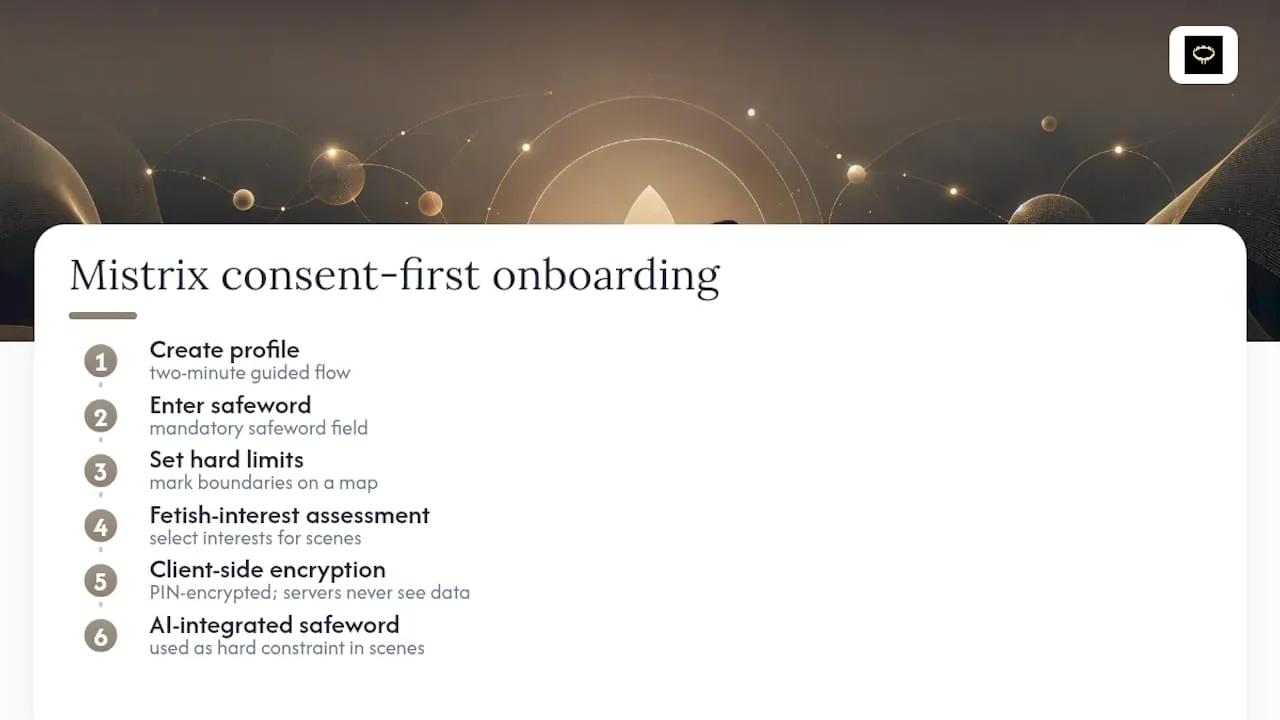
Setting up a safeword with a real partner takes a conversation. On Mistrix, it is part of the roughly ten-minute onboarding, alongside your fetish map and hard limits. In a session the safe word is an always-visible button: one tap ends everything instantly, with no penalty and no in-character pushback. Your hard limits are applied as absolute restrictions to everything the AI plans or writes, and your safe word, limits and fetish map are encrypted on your device with a PIN-derived key, so the server only stores ciphertext it cannot read. If you are new to BDSM, it is a low-pressure way to see how a stop signal should feel when it is respected every time.
For anyone who wants to practice negotiating limits or explore what a consent-first dynamic actually feels like before bringing it to a partner, the AI Dominas on Mistrix offer a private, structured space to do exactly that. You can read more about how the platform handles safewords and hard limits, or check Mistrix pricing to see which tier fits your needs.
Sources
- PMC article (consent and BDSM/community norms)
- NCA TipSheet: Safewords (Trinity College PDF)
- Cambridge Dictionary: safe word
FAQ
What is a safeword and why do you need one?
A safeword is a prearranged word or phrase that signals an immediate stop to an activity. It removes ambiguity from “no” or “stop” during consensual play where those words might be part of the scene.
What was the safeword in Fifty Shades of Grey?
The safewords in Fifty Shades of Grey were “red” (full stop) and “yellow” (slow down), the standard traffic-light system, which reflects real community practice.
What’s a good funny safeword?
“Pineapple,” “rutabaga,” “kumquat,” and “spaghetti” are popular choices. The humor is functional: a silly word is unlikely to slip out accidentally and easy for a partner to recognize as a real signal.
What is a good safeword for couples?
For couples, a single memorable word like “anchor,” “mercy,” or “pineapple” works well. If you want more nuance, the traffic-light system gives you a middle signal (yellow) so you can adjust intensity without a full stop.
Can you use a safeword in non-sexual situations?
Yes. A pause word during arguments or an emergency phrase texted to a trusted contact both follow the same logic: a prearranged signal with a predefined, agreed response.