
A praise kink is arousal from being affirmed, admired and told you are “good”; a degradation kink is arousal from consensual language or acts that lower your status. They sound like opposites, but many people enjoy both, and they can safely share one scene when three things are in place: negotiated limits, an agreed safeword or stop signal, and aftercare that starts the moment the scene ends.
What counts as “degrading” is deeply personal, so the same words can feel thrilling to one person and genuinely hurtful to another. That is why the rest of this guide focuses on negotiation, phrasing and recovery rather than scripts alone.
Table of Contents
- Praise kink vs degradation kink: what each one means
- Why mixing praise and degradation works psychologically
- How to negotiate a scene before you play
- Practical techniques and sample phrasing for balancing both
- Emotional risks, triggers, and aftercare after intense scenes
- How to tell if these kinks suit you and how to integrate them long-term
- Expert-backed protocol for safe praise and degradation play
- How gender identity and sexual orientation shape these dynamics
- Key Takeaways
- Practicing praise and degradation with an AI Domina
- Useful sources for deeper learning
- FAQ
Praise kink vs degradation kink: what each one means
A praise kink centers on arousal from positive reinforcement, affirmation, and adulation. The erotic charge comes from being seen, validated, and celebrated by a partner. The intensity spectrum runs wide:
- Low intensity: “You’re doing so well” or “I’m proud of you.”
- Moderate intensity: Extended verbal worship, repeated affirmations tied to obedience or performance.
- High intensity: Full adoration rituals where every action earns explicit, elaborate praise from a dominant partner.
A degradation kink involves consensual use of derogatory language or actions designed to induce a sense of lowered status, shame, or objectification for erotic arousal. The key word is consensual. Examples across the spectrum:
- Low intensity: Light teasing, playful name-calling agreed upon in advance.
- Moderate intensity: Commands framed as corrections, explicit reminders of submissive status.
- High intensity: Deep humiliation scenes, objectification play, or verbal degradation tied to physical acts, all within pre-negotiated limits.
Three related concepts often get conflated, and the distinctions matter. Degradation lowers perceived status; humiliation centers on shame; objectification strips agency. Ethical play requires knowing which one you’re engaging and why. A scene can involve all three, but each carries different emotional weight and different aftercare needs. Neither kink is inherently pathological. Both exist on a spectrum, and most people who explore them find their own sweet spot somewhere in the middle.
Why mixing praise and degradation works psychologically
The short answer: contrast creates intensity. Rapid shifts between affirmation and belittlement force emotional state changes that heighten arousal when managed safely. This is sometimes called the push-pull dynamic, and it works because the nervous system responds strongly to abrupt transitions between reward and threat signals.
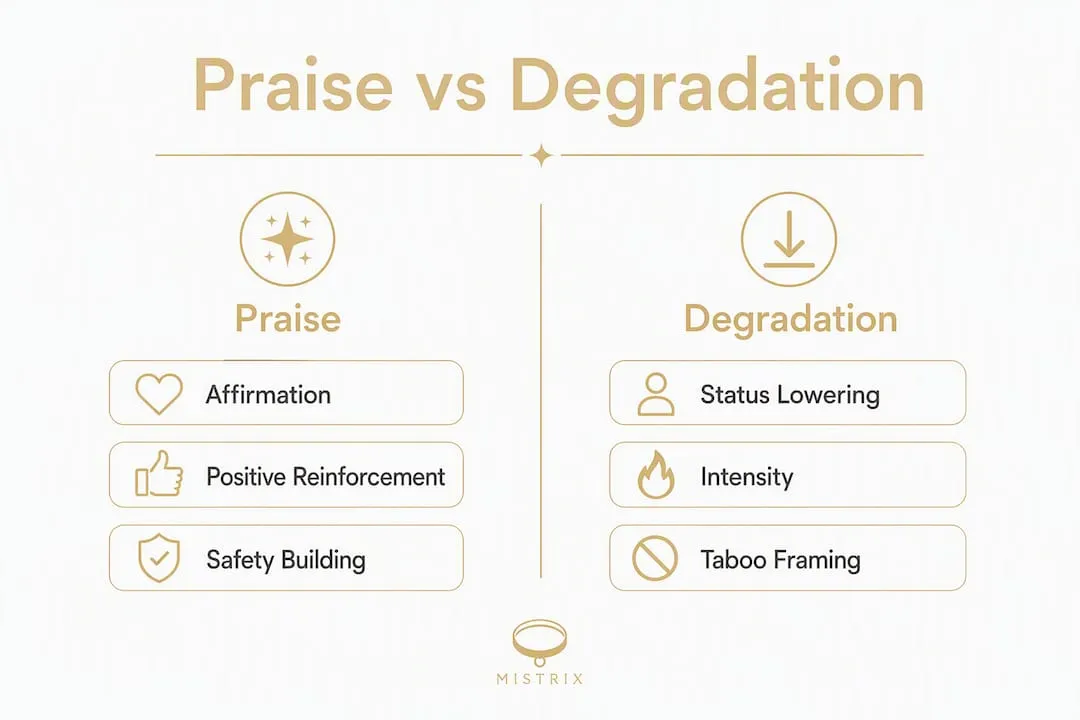
Several psychological mechanisms drive this. Taboo framing plays a major role. Degradation play generates intensity partly because it uses taboo behavior in a consensual setting; the “wrongness” becomes a controlled psychological device rather than actual harm. Reward and feedback loops also matter: praise activates the brain’s reinforcement pathways, and degradation introduces a controlled stressor. Alternating between them keeps the emotional state dynamic and prevents habituation. Oxytocin, released during intimacy and reassurance, and adrenaline, triggered by the stress of degradation, interact in ways that many people describe as deeply immersive.
Three short staging examples show how this plays out in practice. In a praise-led scene, a dominant opens with sustained affirmation, then introduces a single degrading command near the peak, then returns to praise during wind-down. In a degradation-led scene, the dominant opens with firm, lowering language and closes with warm reassurance and explicit verbal care. In a true sandwich structure, praise bookends a degradation peak: affirmation, then escalation, then a deliberate return to affirmation that signals the scene is closing. Pairing them often creates stronger arousal than either alone because the abrupt emotional contrast is itself the experience.
How to negotiate a scene before you play
Good negotiation is the single act that separates kink from harm. Do it before every scene, not just the first one. Here’s a step-by-step checklist you can adapt:
- State your goals. Each partner names what they want from the scene: emotional tone, intensity level, and specific acts they’re hoping to include.
- Establish hard limits. Hard limits are non-negotiable stops. Write them down. Common examples: specific slur categories, body areas, public elements, recording.
- Identify soft limits. Soft limits are areas you’re uncertain about. Flag them so the dominant can approach with extra care or avoid entirely.
- Name trigger words or phrases. Some language carries real-world weight that can resurface unexpectedly. Identify it in advance.
- Choose a safeword. Traffic-light systems (red/yellow/green) work well for most scenes. For noisy environments or scenes involving restraint, agree on a nonverbal signal: three taps, a hand squeeze, or dropping a held object.
- Set check-in timing. Agree on when the dominant will pause to check in verbally, especially during high-intensity degradation.
- Confirm aftercare expectations. Decide in advance what aftercare looks like: physical comfort, verbal reassurance, time alone, or a combination.
A simple opening script: “Before we start, I want to make sure we’re aligned. Here’s what I’m hoping for, here’s what’s off the table, and here’s my safeword. What do you need from me?” Keep it conversational, not clinical.
For documentation, a private shared note or a printed checklist works well. Privacy-conscious documentation matters: avoid storing sensitive limit details in apps that sync them to a server in readable form. A handwritten note kept privately is often the safest option.

Practical techniques and sample phrasing for balancing both
Delivery matters more than the exact words you choose. Tone, eye contact, timing, and personalization determine whether a phrase lands erotically or breaks the scene entirely. A generic insult delivered flatly will almost always feel wrong; the same phrase delivered with deliberate eye contact and a controlled voice can feel electric.
The intensity ladder
Think of intensity as a dial, not a switch. A useful sequencing framework runs: warm-up → peak → recovery → aftercare.
During warm-up, keep praise dominant and degradation minimal. This builds trust and emotional safety. At the peak, you can shift the balance toward degradation, using pre-negotiated language at the agreed intensity. Recovery starts immediately after the peak: reduce degradation, increase reassurance, and begin the transition back to baseline. Aftercare follows.
Delivery tips
Keep your voice controlled and intentional. Rushed or uncertain delivery signals discomfort to your partner and breaks immersion. Personalize language to the specific person, not a generic archetype. Avoid phrases that reference real-world insecurities you haven’t explicitly cleared. Test new phrasing at low intensity first.

Pro Tip: Before introducing a new degrading phrase, test it in a low-stakes moment outside a full scene. Ask your partner directly: “How does this land for you?” Their answer tells you more than any script.
Emotional risks, triggers, and aftercare after intense scenes
Emotional risk in degradation and praise play is real, but it’s manageable with strong aftercare and consistent monitoring. The risk isn’t the kink itself; it’s the gap between what was negotiated and what actually happened emotionally.
Common risks and triggers to watch for:
- Unexpected shame. Degradation can surface shame that wasn’t present during negotiation. This is normal but requires immediate acknowledgment.
- Resurfaced trauma. Certain language or power dynamics can activate past experiences. This is why trigger-word identification in negotiation matters so much.
- Relationship miscommunication. If one partner carries scene language into daily life without explicit agreement, it can erode trust quickly.
- Context confusion. Identical words can be degrading in public and erotic in a negotiated scene. Blurring that line is a genuine risk.
- Manipulation risk. Degradation can be harmful when used to vent resentment or erode self-worth outside a consensual container. Ethical play requires self-awareness about motivation.
Aftercare protocol
Aftercare and debriefing are the difference between a fulfilling session and a damaging one after intense degradation play. A practical protocol:
- Immediate grounding (0-10 minutes): Physical comfort first. Blanket, water, skin contact if desired. No analysis yet.
- Verbal reassurance (10-20 minutes): The dominant explicitly affirms the submissive’s worth and separates scene identity from real identity. “That was a scene. You are not what I called you. You are [name], and I care about you.”
- Debrief (20-60 minutes or the next day): Talk through what worked, what felt off, and what either partner wants to adjust. Keep it collaborative.
- Follow-up check-in (24-48 hours later): A brief message or conversation to confirm both partners are processing well.
Signs that require pausing play or seeking professional support: persistent mood changes lasting more than a day or two, sleep disturbances, intrusive thoughts about scene content, or a partner withdrawing emotionally. For trauma-informed support, kink-aware therapists are listed through the American Association of Sexuality Educators, Counselors and Therapists (AASECT) and the National Coalition for Sexual Freedom (NCSF). The Crisis Text Line (text HOME to 741741) is available 24/7 for immediate support.
How to tell if these kinks suit you and how to integrate them long-term
Start with curiosity, not a label. You don’t need to decide whether you “have” a praise kink or a degradation kink before you explore. What matters is honest self-reflection about what you’re drawn to and why.
Self-check questions
Work through these privately before any conversation with a partner:
- Do you feel a strong emotional response (positive or negative) when someone praises your performance or obedience? What does that response feel like physically?
- Does the idea of being verbally lowered or commanded by a trusted partner feel arousing, neutral, or uncomfortable?
- Are there specific words or phrases that feel exciting in fantasy but that you’d want to avoid in practice?
- How do you typically feel after receiving intense criticism, even constructive criticism, in everyday life?
- Can you clearly separate a scene persona from your daily identity, or does that feel difficult to imagine?
- Do you have any past experiences with verbal abuse or trauma that might make certain language land differently than intended?
Conversation starters with a partner
“I’ve been curious about [praise/degradation] play. Can we talk about what that might look like for us, starting really low-intensity?” Or: “I want to try something new. Can we spend 20 minutes just talking about what words feel good and what words feel off-limits?”
Long-term integration
Ritual versus spontaneous play is a real distinction. Scheduled scenes with explicit negotiation tend to work better for degradation play, especially early on, because they create a clear container. Spontaneous praise is generally lower-risk and can be woven into daily dynamics more freely. Equity in the power exchange matters: the submissive partner’s limits and emotional state should carry equal weight in every negotiation, regardless of how the scene is framed. Separate scene identity from daily life deliberately. A post-scene ritual, a specific phrase, or even changing clothes can help mark the transition.
Pause integration if a partner expresses persistent discomfort, if consent boundaries feel unclear after multiple conversations, or if either partner notices the dynamic bleeding into non-scene interactions without agreement.
Expert-backed protocol for safe praise and degradation play
A repeatable four-step protocol, Assess, Negotiate, Play, Aftercare, reduces risk and improves outcomes across scene types. Here’s how each step works in practice.
Assess means checking in with yourself and your partner before any scene. Are both people in a stable emotional state? Are there any recent stressors that might make certain language land harder than usual? A two-minute verbal check-in before starting is enough.
Negotiate follows the checklist from the earlier section. For scenes that mix praise and degradation, pay particular attention to the intensity ratio: how much of each, in what order, and what signals a shift. Document limits privately.
Play means executing the scene within the agreed container. The dominant monitors the submissive’s physical and verbal cues throughout. If something feels off, pause and check in. What constitutes a degrading act is highly subjective, so even well-negotiated scenes can produce unexpected reactions. Build in natural pause points.
Aftercare runs the full protocol described above. Don’t abbreviate it after intense scenes.
For a low-risk test session: agree on a 15-minute scene using only low-intensity language from your negotiated list. Use the traffic-light safeword system. Debrief immediately afterward, focusing on what felt right and what you’d adjust. Run two or three sessions at this level before escalating intensity.
On privacy: avoid storing scene scripts or limit lists in unencrypted cloud apps. A private note on a PIN-locked device, or a physical document kept securely, is the safer choice. Never record a scene without explicit, prior consent from all participants.
How gender identity and sexual orientation shape these dynamics
Praise and degradation kinks don’t land the same way across gender identities and sexual orientations, and pretending otherwise misses something important. The meaning of specific language, the power dynamics at play, and the emotional risks involved all shift depending on who is in the scene and what cultural weight certain words carry for them.
For cisgender women in heterosexual dynamics, degradation play often intersects with deeply ingrained social messaging about worth, desirability, and submission. Language that feels erotically charged in a negotiated scene can carry real-world baggage that requires more careful aftercare. Praise, conversely, can tap into validation needs that are socially conditioned rather than purely erotic, which is worth examining honestly.
For gay and bisexual men, degradation dynamics frequently interact with internalized homophobia or body image pressures. Certain slurs reclaimed within a community context may be erotically charged for one person and deeply harmful for another, even within the same demographic. The subjectivity of what counts as degrading is especially pronounced here.
Transgender and nonbinary individuals often navigate an additional layer: language that references gender in a degrading way can intersect with dysphoria in unpredictable ways. Explicit negotiation around gendered language, pronouns used in scene, and body-related phrasing is not optional for these dynamics. It’s the foundation.
Across all orientations, the dominant/submissive role assignment doesn’t map neatly onto gender. Women dominate men, men submit to men, nonbinary people hold dominant roles. The American Counseling Association practice brief on kink culture explicitly note that kink dynamics are not predictive of or determined by gender identity or sexual orientation. Equity in negotiation means both partners’ limits carry equal weight regardless of who holds the dominant role in the scene.
Key Takeaways
Praise and degradation can coexist safely in kink when consent is explicit, limits are documented, and aftercare is non-negotiable.
| Point | Details |
|---|---|
| Consent is the foundation | Explicit negotiation of hard limits, trigger words, and safewords before every scene. |
| Intensity ladder | Scale from warm-up praise through degradation peak to recovery, then aftercare, in sequence. |
| Delivery over words | Tone, timing, and personalization determine whether a phrase lands erotically or causes harm. |
| Aftercare is structural | Verbal reassurance, debrief, and a 24-48 hour follow-up check-in after every intense scene. |
| Solo practice helps | A private AI Domina lets you notice how praise and degradation land for you before negotiating them with a partner. |
Practicing praise and degradation with an AI Domina
If you want to explore how these dynamics feel before bringing them into a real-partner scene, an AI Domina is one private way to do it. Mistrix’s onboarding includes a short experience quiz, a fetish map, hard limits and a safe word, so every written session starts from a clear baseline. Your fetish map, hard limits, safe word and chats are encrypted on your device with a PIN-derived key, so the server stores only data it cannot read.
You can use Mistrix to test specific phrases at low intensity, work through an AI-guided BDSM session, or explore how praise and degradation dynamics feel before negotiating them with a partner. You can pick one of the preset Dominas whose style fits you, from warm and praising to strict and cutting. Nothing replaces negotiated consent with a real partner, but Mistrix gives you a private, structured space to understand your own responses first. The free tier includes one full session per day, and the onboarding quiz and fetish map help you pin down your preferences.
Useful sources for deeper learning
These sources cover research, practitioner guidance, and trauma-informed resources for anyone who wants to go further.
| Source | Type | Date |
|---|---|---|
| Men’s Health / Dr. Justin Lehmiller: degrading sex acts | Practitioner/research | Not publicly listed |
| BrandonTheDom: Degradation Kink | Practitioner guide | Not publicly listed |
| DoubleList: Degradation Kink explainer | Educational | Not publicly listed |
| American Counseling Association: Kink Culture Practice Brief | Clinical/professional | 2020 |
| Corpus & Good: Effects of Praise on Intrinsic Motivation | Academic research | Not listed |
| Mistrix: Trauma-Informed BDSM | Brand resource/guide | Not listed |
| Mistrix: Documenting Consent BDSM | Brand resource/guide | Not listed |
| Passionfruit: Praise and Degradation Kinks Unpacked | Practitioner/educational | Not publicly listed |
Annotation notes: The ACA practice brief is the most clinically authoritative resource on kink culture for therapists and clients. The Corpus & Good paper on praise and motivation provides useful psychological grounding for understanding why affirmation carries erotic weight. Mistrix’s trauma-informed BDSM guide is a brand resource and should be read as such, but it covers aftercare and consent in practical detail.
This article is general information, not professional advice. Confirm current guidance with a kink-aware clinician or AASECT-listed therapist for your specific situation.
FAQ
What does it mean to have a degradation kink?
A degradation kink means you find consensual derogatory language or status-lowering acts erotically arousing. It requires prior negotiation of limits and language, and it ranges from mild teasing to intense humiliation within an agreed frame.
What is the kink called when you like being praised?
It’s called a praise kink. Arousal comes from affirmation, positive reinforcement, and adulation from a partner, and it often pairs with submission or obedience dynamics.
How do I tell if I have a praise kink?
Ask yourself whether you feel a strong erotic or emotional charge when a partner explicitly validates your behavior or performance. If praise during intimacy consistently heightens arousal or emotional connection, that’s a reliable signal.
How do you mix praise and degradation in the same scene?
Use a sequencing framework: open with praise to establish safety, shift to degradation at the negotiated intensity peak, then return to explicit affirmation during recovery. This “sandwich” structure uses emotional contrast to heighten arousal while keeping the submissive partner grounded.
When should you stop or seek help after a degradation scene?
Pause and seek support if either partner experiences mood changes lasting more than a day or two, intrusive thoughts about scene content, sleep disturbances, or emotional withdrawal. Kink-aware therapists are listed through AASECT and the National Coalition for Sexual Freedom.