
Trauma-informed BDSM is a way of practicing kink that assumes anyone involved may carry trauma, and builds that awareness into negotiation, scenes and aftercare: naming possible triggers, using signals that work even when someone freezes, and slowing down or stopping without blame. It is a safety practice, not a form of therapy, and it works best alongside professional support for anyone actively working through trauma.
What is trauma-informed BDSM and why does it matter?
Trauma-informed BDSM weaves trauma awareness into every layer of kink, from negotiation to aftercare. It goes well beyond standard safe, sane, and consensual frameworks by asking participants to understand how trauma shapes the nervous system, triggers emotional responses, and affects the capacity to consent in real time.
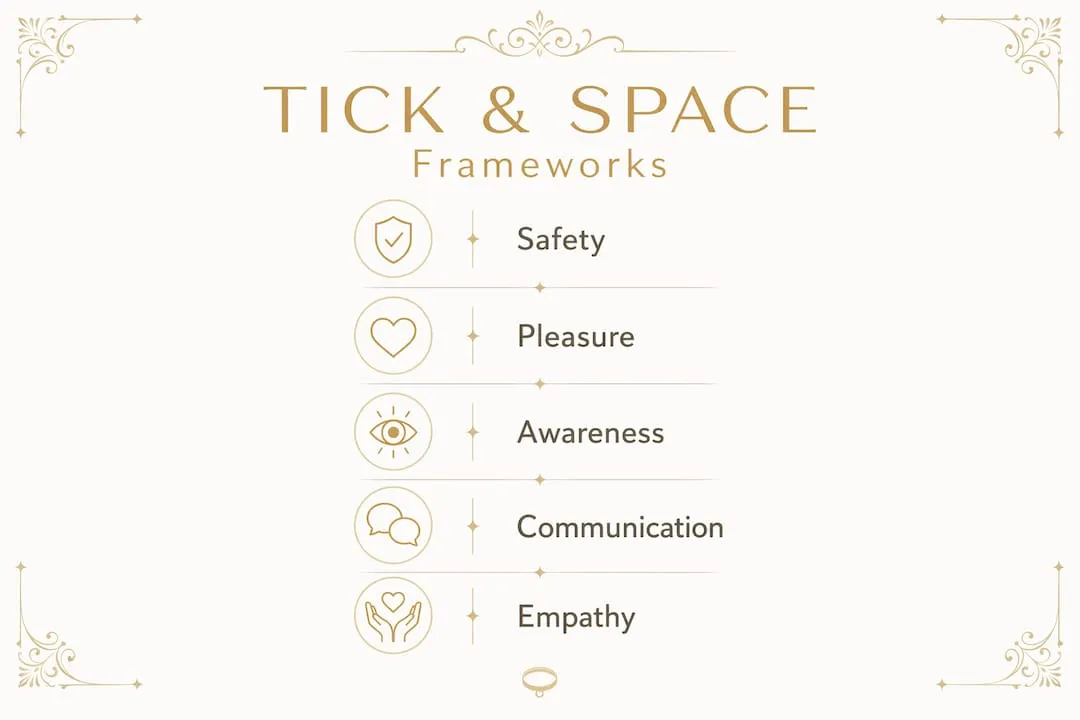
One well-known framework is TICK, which stands for Trauma-Informed Consensual Kink. Developed by Black+ practitioners and educators, TICK uses the SPACE methodology to structure every interaction:
- Safety: Physical and emotional safety are non-negotiable starting points, not afterthoughts.
- Pleasure: Centering pleasure as a legitimate healing goal, not just a byproduct.
- Awareness: Staying attuned to your own and your partner’s nervous system states throughout a scene.
- Communication: Ongoing, explicit dialogue before, during, and after play.
- Empathy: Holding space for trauma responses without judgment or shame.
What separates trauma-informed kink from general BDSM is trauma literacy. Practitioners actively learn to recognize dissociation, freeze responses, and emotional flooding, and they build those possibilities into their scene planning from the start. The AASECT has featured TICK specifically as a model for healing and consent within kink communities, with particular attention to Black+ individuals and other marginalized groups.
Can BDSM support healing from trauma?
Some survivors describe consensual kink as part of their recovery, but it is not a treatment and it can also do harm. A 2021 study of 20 adults with early abuse histories identified six key themes of recovery through kink, including liberation through relationship and redefining pain. Participants described reclaiming agency over their bodies and rewriting the meaning of experiences that had once felt violating.
Participants often describe the experience in bodily terms: consensual power exchange gave them a structured way to move through fear, surrender and control with a trusted partner, with the power to stop at any moment. That is their account, not a guarantee; outcomes vary widely from person to person.

The critical distinction is between healing reenactment and retraumatization. Healing reenactment is conscious, negotiated, and boundaried. Retraumatization happens when a scene activates trauma without the safety structures to process it. The difference is not the content of the scene but the quality of the container around it. Trauma-informed kink builds that container deliberately. Clinicians are paying attention too: the APA has offered a continuing education course on kink and past trauma for professionals.
Setting consent, boundaries, and safety for trauma survivors
Standard safe words are a starting point, not a complete safety system. Trauma-informed negotiation goes further by including explicit trauma disclosure, discussion of potential unknown triggers, and a clear framework for renegotiation without shame or justification. Research with survivors who practice kink describes experiences of retraumatization and the role safeguards like ongoing consent and tested safewords played, which underscores why these protocols exist.
Consent in trauma-aware practice follows three principles: it must be continuous, specific, and reversible. Community frameworks like SSC (Safe, Sane, Consensual), RACK (Risk-Aware Consensual Kink), and PRICK (Personal Responsibility, Informed Consensual Kink) all emphasize these consent principles as the floor, not the ceiling.
Non-verbal emergency signals are equally important. In altered states like subspace, verbal safewords can become inaccessible. Experienced practitioners use tap-outs or dropped objects as physical signals, and these must be rehearsed before a scene, not improvised during one.
Aftercare deserves its own serious attention. Many practitioners treat it as a stabilization phase that can last hours, covering physical grounding, emotional processing, and a gradual return to baseline, with a check-in in the days after (see BDSM aftercare and sub drop). Every participant in a scene needs aftercare, not just the submissive.
Pro Tip: Learn to distinguish a trauma response from subspace. Subspace typically involves a warm, floaty dissociation with maintained body awareness. A trauma freeze response often looks similar but comes with emotional numbness, shallow breathing, and a blank or frightened expression. Slowing the scene and checking in verbally can clarify which state you are witnessing.
Cultural considerations and challenges in BDSM communities
Race and identity shape the experience of BDSM in ways the community has been slow to address. A U.S. study of 398 practitioners found that people of color reported far more discrimination and fetishization in kink spaces than white practitioners. That reflects a structural problem, not isolated incidents.
For trauma survivors who also hold marginalized identities, BDSM spaces can reproduce the very dynamics they are trying to heal from. Fetishization of race, disability, or gender identity without consent is not kink. It is harm. Trauma-informed communities recognize this and build culturally relevant frameworks, like TICK’s explicit centering of Black+ experiences, to address it directly.
Mental health stigma compounds these barriers. Therapists have historically pathologized BDSM interest, and research documents how clinicians’ negative misconceptions have led to unethical practices and harmful therapeutic outcomes for kink-involved clients. Trauma survivors navigating both a BDSM identity and a therapy relationship often carry the burden of educating their own clinician, which is an exhausting and unfair position.
How kink-affirming therapy supports trauma healing
Kink-affirming therapy treats BDSM as a natural part of human sexual diversity rather than a symptom to be corrected. For trauma survivors, this distinction is the difference between a therapeutic relationship that helps and one that harms.
A skilled kink-affirming therapist helps clients distinguish between healing reenactment and retraumatization, process what surfaces during scenes, and build the self-awareness needed to engage in BDSM safely. The Society for Psychotherapy has published guidance on this trauma-informed understanding, pushing clinicians toward competence rather than avoidance. If you are a trauma survivor exploring kink, finding a therapist who is genuinely kink-affirming, not merely tolerant, can make a real difference. Directories such as Kink Aware Professionals are one place to start.
Where an AI companion fits, and where it does not
Some people prefer to explore kink privately first, at their own pace, before involving a partner. Mistrix is an AI companion for femdom and BDSM in written chat, and a few of its safeguards line up with trauma-informed practice:
- Hard limits: set during onboarding and applied as absolute restrictions to every session, task and scene, so topics you exclude never come up.
- One-tap safe word: an always-visible button that ends everything instantly, with no penalty and no questions.
- Private by design: your fetish map, hard limits, safe word and chats are encrypted on your device with a key derived from your PIN, so the server stores only ciphertext it cannot read.
- Pacing: an experience quiz at onboarding sets your level, and there are gentler characters as well as stricter ones. On Premium you can build your own Domina with the tone you want.
To be clear: an AI companion is not therapy, cannot recognize a trauma response the way a trained person can, and is no substitute for a kink-aware therapist. If sessions bring up distress, stop, use the safe word, and talk to a professional or someone you trust. More on how limits work is in our guide to hard limits, and on privacy in the encryption guide.
Training and resources for practitioners
Becoming trauma-informed as a BDSM practitioner is an ongoing commitment, not a one-time certification. Professional bodies such as AASECT have featured TICK and trauma-informed kink in their education for clinicians and educators, and it is worth looking for workshops run by kink-aware therapists.
Community-level resources matter just as much. Organizations like the National Coalition for Sexual Freedom (NCSF) provide legal and educational support for kink practitioners, and some local communities include trauma awareness in their workshops and dungeon monitor training. Reading peer-reviewed research, particularly the growing body of work on BDSM and psychological wellbeing, gives practitioners the evidence base to make informed decisions. The goal is not to become a therapist but to understand enough about trauma responses to hold a scene safely and know when to stop.
Ethical considerations unique to trauma-informed BDSM
Power dynamics in BDSM carry ethical weight that intensifies when trauma is present. Dominants and tops in trauma-informed dynamics take on a responsibility that goes beyond scene facilitation. Trauma literacy is a core part of that responsibility. A dominant who does not understand dissociation, freeze responses, or emotional flooding cannot safely hold a trauma survivor in a power exchange.
Informed consent in this context means more than a checklist. It means understanding that a person’s stated limits may shift as a scene progresses, that past consent does not guarantee present consent, and that a submissive in a trauma response may not be able to advocate for themselves in the moment. Ethical practice builds in check-ins, pacing, and the explicit permission to stop without explanation. The Duluth Model’s framework for distinguishing power-over abuse from consensual power exchange is a useful reference point for practitioners working through these distinctions.
Supporting partners with complex trauma or PTSD in BDSM dynamics
Partners with complex trauma or PTSD need a slower, more deliberate approach to kink. Complex trauma, which often stems from repeated childhood abuse or prolonged relational harm, affects the nervous system differently than single-incident trauma. Triggers can be unpredictable, and emotional regulation under stress is harder.
Practical support starts before the scene. Discuss not just hard and soft limits but also potential unknown triggers and what a trauma response might look like for your specific partner. Agree on what happens if a response occurs: who takes the lead, what grounding techniques you will use, and how long aftercare will last. Revisit these agreements over time; our guide to ongoing consent in BDSM covers how. During a scene, slower pacing and frequent verbal check-ins give a trauma survivor the ongoing reassurance that they remain in control of the experience. After a scene, follow up the next day. The 24-hour window after intense play is when emotional processing often surfaces, and a brief check-in can prevent a healing experience from tipping into distress.
Key Takeaways
Trauma-informed BDSM combines frameworks like TICK and SPACE, continuous consent, and kink-affirming professional support to make kink safer for people with trauma histories.
| Point | Details |
|---|---|
| TICK and SPACE are foundational | The TICK framework structures trauma-aware kink through Safety, Pleasure, Awareness, Communication, and Empathy. |
| Healing vs. retraumatization | The difference lies in the quality of the safety container, not scene content; kink is not a substitute for therapy. |
| Racial disparities are documented | Research reports much higher discrimination and fetishization for people of color in kink spaces. |
| Non-verbal signals are required | Tap-outs and dropped objects must be rehearsed before scenes where verbal safewords become inaccessible. |
| Aftercare is stabilization | Plan aftercare for everyone involved, plus a check-in in the days after. |
| Get professional support | A kink-affirming therapist is the right place to work through trauma; an app or a partner is not. |
FAQ
What is trauma-informed kink?
Trauma-informed kink, formalized as TICK (Trauma-Informed Consensual Kink), is a BDSM consent approach that integrates trauma awareness into negotiation, scene design, and aftercare to support healing and reduce the risk of retraumatization.
What are the five points of the TICK methodology?
The TICK framework uses the SPACE approach: Safety, Pleasure, Awareness, Communication, and Empathy. These five principles structure every stage of trauma-aware BDSM practice.
What is the psychology behind kink and trauma healing?
Some research suggests consensual power exchange can help some survivors reclaim a sense of agency, though it is not a treatment. A 2021 study identified liberation through relationship and redefining pain as key recovery themes among adults with early abuse histories.
What is trauma-informed intimacy?
Trauma-informed intimacy means engaging in any intimate or sexual practice with active awareness of how trauma affects the nervous system, consent capacity, and emotional responses, and building explicit safeguards to honor those realities throughout the interaction.