
Humiliation kink boundaries are explicitly negotiated limits that define which words, actions, and scenarios are acceptable during erotic humiliation play, and which are off the table. Without them, what could be an intensely pleasurable experience risks becoming genuinely harmful. The key distinction: humiliation reduces status or dignity within a consensual scene, while degradation targets identity more specifically. Most degradation scenes involve humiliation, but not every humiliation scene escalates into explicit degradation. Knowing which you want, and communicating it precisely, is where safe play begins.
Your boundaries in this space fall into four categories:
- Hard limits: Absolute no’s. Non-negotiable, no justification required.
- Soft limits: Conditional yes’s. They require specific circumstances and explicit agreement before anything happens.
- Must-limits: Requirements, not restrictions. “I need verbal aftercare” is as binding as any prohibition.
- Relational boundaries: How you are treated across the entire dynamic, not just inside scenes.
Why humiliation kink boundaries demand more than standard BDSM consent
Humiliation is emotional impact play, and that changes everything about how consent needs to work. A generic “I’m into degradation” tells your partner almost nothing useful. One person’s erotic phrase is another’s genuine wound. The only safe approach is detailed, granular negotiation of specific language, themes, and intensity levels before any scene begins.

This is also where humiliation differs from most other kink activities. Physical play targets the body, which gives you clear, observable signals. Humiliation targets identity and past emotional wounds, making the damage less visible and sometimes delayed. You can safeword out of a scene, but you cannot always safeword out of your own head once certain words have landed.
What actually draws people to humiliation kink
The psychology here is more layered than it first appears. The appeal usually centers on controlled vulnerability and erotic power exchange: the pleasure of surrendering control within a container you built yourself. For many submissives, the intensity of feeling exposed or diminished, held safely by a partner who genuinely cares, produces a specific kind of trust that is difficult to access any other way.
There is a real paradox at the core of this kink. It challenges your sense of identity, which makes it psychologically risky. Yet with the right trust and communication, that same challenge can be deeply transformative. The submissive is actually the power broker in the exchange: they define the limits, hold the safeword, and initiate the desire. The Dominant’s role is one of immense emotional responsibility, not just delivery of a script.
- The erotic charge often comes from the contrast between harsh content and the deep care surrounding it.
- Shame becoming pleasurable is a genuine psychological mechanism, not a sign of dysfunction.
- Humiliation play can offer real self-exploration, helping you understand your emotional responses within a safe, negotiated context.
The main types of humiliation play and what each requires
Understanding the categories helps you negotiate with precision rather than vague gestures.
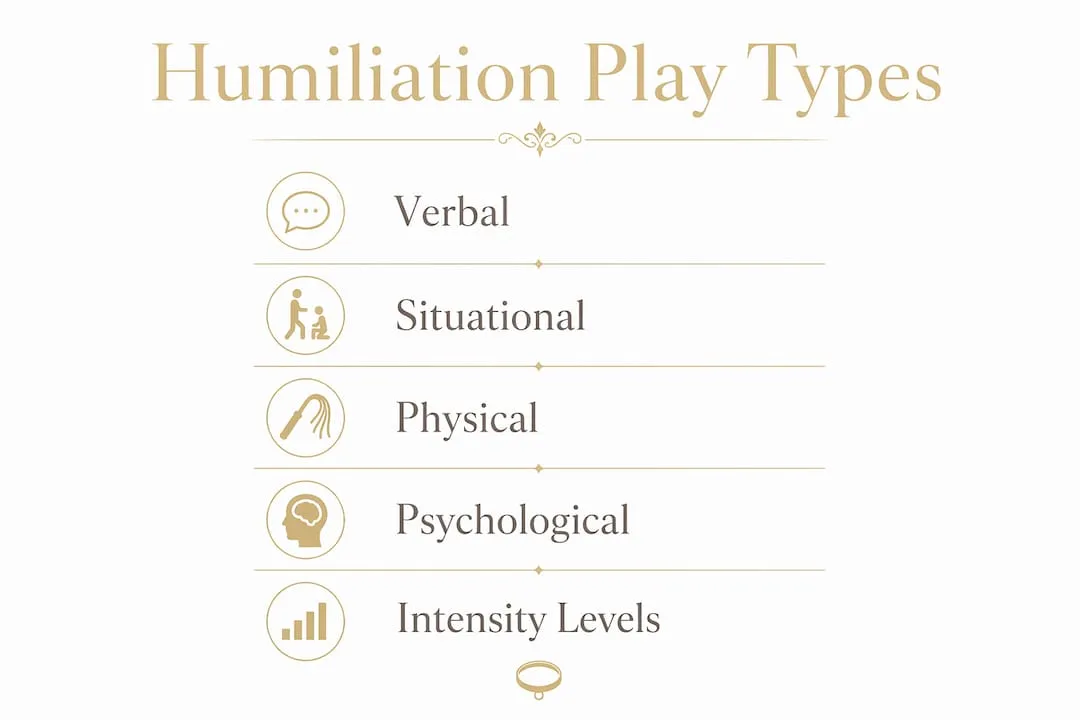
Verbal degradation is the most common entry point (our guide to praise kink vs degradation kink covers how it pairs with affirmation). It uses negotiated terms: status-diminishing labels, role-based identity words, and affect-targeting phrases. There is no universal word list. What reads as intensely erotic for one person triggers genuine distress in another, which is exactly why pre-scene negotiation of specific terms is non-negotiable.
Situational humiliation places the submissive in a physically or socially subservient role: serving the Dominant, being ignored during a scene, being treated as furniture. This form tends to be less verbally intense but can carry significant psychological weight depending on the submissive’s relationship to social status and visibility.
Sexual objectification treats the submissive’s body as a tool or commodity. The submissive’s experience during objectification is often intensely inward, almost meditative. Aftercare for this form typically needs to refocus on mutual desire and the whole person, not just the role.
A few additional forms worth knowing:
- Public or exhibitionist humiliation: Sending voice notes, embarrassing tasks in semi-public settings. Always negotiate digital sharing and public exposure separately and explicitly.
- Ritual subjugation: Formalized acts like kneeling for permission, using specific titles, scripted entry and exit rituals.
- Written or task-based humiliation: Assignments, lines, degrading labels worn over time. These require clear limits on duration, privacy, and record-keeping.
The level of emotional intensity correlates directly with the depth of negotiation required. A light verbal scene needs a check-in. A scene involving public exposure or deep identity-level degradation warrants a written agreement and multiple post-scene check-ins.
How to negotiate humiliation kink limits before you play
Effective negotiation for this kink requires clinical precision in language. Vague terms create ambiguity, and ambiguity is the enemy of consent. Here is how to build a negotiation that actually protects both of you.

Start with a humiliation inventory. A written inventory categorizes specific words, actions, and scenarios as green (approved), yellow (conditional), or red (off-limits). Cover body-related insults, intelligence-based language, sexuality-based phrases, family references, and anything tied to real identity markers like race, gender identity, or disability. Real identity categories require a separate, explicit conversation because those words follow you outside the scene.
Distinguish your limit types clearly:
- Hard limits: state them plainly. “That is a hard limit for me” is a complete sentence.
- Soft limits: state the conditions. Not “spanking is a maybe” but “yes to that if we start light and you check in.”
- Must-limits: name your requirements. “I need verbal aftercare, that is not optional.”
Agree on intensity levels. Many partners find it useful to define soft, medium, and hard degradation categories so the submissive can request a level based on their emotional state that day. Humiliation is not a fixed-intensity kink. It changes with life context, stress, and trust.
Build your safeword system. The traffic light system works well: green means continue, yellow means slow down or check in, red means stop immediately. Because humiliation play can make verbal communication difficult, you also need backup non-verbal signals. Tapping, hand squeezes, or a dropped object can serve as a red signal when speech is impaired by the scene’s intensity.
Never renegotiate limits during a scene. If something comes up mid-scene that was not discussed beforehand, pause or stop. Both partners’ judgment is compromised during active play. New territory gets discussed before it gets explored.
Apply the Default-to-Hard-Limit principle: anything not explicitly negotiated is a hard limit. You do not need a comprehensive catalog of everything you will not do. The default is no.
Pro Tip: Before your first humiliation scene, each partner independently completes the inventory, then compares notes. Doing it separately removes the social pressure of real-time reaction and produces more honest answers.
Aftercare, emotional safety, and managing stigma
Aftercare is not optional in humiliation kink. If humiliation is emotional impact play, aftercare is emotional repair. The submissive may feel shaky, exposed, or suddenly quiet after arousal fades. That is the nervous system processing intensity, not a sign the scene went wrong.
Good aftercare combines physical comfort (warmth, water, cuddling) with verbal reassurance. Many submissives need to hear clearly: “That was play. I respect you. You are safe.” This is not breaking the kink. It is completing the erotic contract. Dominants also need aftercare: verbal feedback, hydration, and space to land emotionally after holding that much power.
Debriefing, either immediately or a day later, turns risky intensity into a trust-building ritual. Discuss what worked, what landed wrong, and what you want to adjust. This is where boundaries become living agreements rather than static rules. When a boundary gets crossed reactively, the healthy response is to let the emotional reaction pass, then have a grounded conversation. Explain what happened, clarify it was not the other person’s fault if the limit was not previously stated, and communicate how you want to be treated going forward.
Stigma is a real factor for many people exploring this kink. Internalized shame about enjoying humiliation can surface after scenes, especially early on. A few strategies that help:
- Separate fantasy from identity. What arouses you in a scene does not define your worth or your values outside it.
- Find community. Kink-affirming spaces and educators normalize the experience without requiring you to justify it.
- Consider a kink-affirming therapist if past trauma intersects with your play. Those carrying deep emotional wounds benefit from professional support before entering high-intensity humiliation dynamics.
Pro Tip: After intense scenes, try a specific reconnection ritual: repeating affirming phrases, shared quiet time, or journaling together. Rituals of closure help both partners’ nervous systems return to baseline and reinforce the care beneath the scene.
What experts say about psychological safety in humiliation play
The therapeutic and BDSM education community is consistent on one point: language in humiliation play functions as a powerful psychological stimulus targeting identity, and that demands a level of care most people underestimate.
Therapists working with BDSM practitioners consistently note that reactive boundary crossings should be handled through de-escalation and understanding unmet needs, not panic or blame. The frameworks SSC (Safe, Sane, Consensual) and RACK (Risk-Aware Consensual Kink) both emphasize that risk cannot be fully eliminated, but it can be owned consciously through trust and communication.
Dominants specifically need to watch for survival responses during intense scenes: sudden quietness, lack of eye contact, or robotic behavior can indicate dissociation or fawning rather than genuine engagement. These signs require an immediate pause and check-in. Compliance that looks like consent is not always consent.
Exploring humiliation with an AI Domina
If you want to explore verbal humiliation privately first, Mistrix applies the same principles to written sessions. During onboarding you set hard limits and a safe word; hard limits are injected as absolute restrictions into everything your Domina plans or writes, and the always-visible safe word button ends a session instantly, without penalty. Your AI Domina works from your fetish map and learns your limits and history over time. Your fetish map, limits, safe word and chats are encrypted on your device with a PIN-derived key. It does not replace negotiation with a real partner, but it is a low-pressure way to find out which words land and which do not.
Key Takeaways
Humiliation kink boundaries require explicit, granular negotiation of specific language, scenarios, and intensity levels, backed by a clear safeword system and structured aftercare.
| Point | Details |
|---|---|
| Hard limits are absolute | A hard limit is a non-negotiable no; it requires no justification and cannot be overridden mid-scene. |
| Default to hard limit | Anything not explicitly negotiated is a hard limit by default, so the burden is always on getting a yes. |
| Verbal precision protects both partners | Vague terms in negotiation increase the risk of real emotional harm; specific word lists and inventories reduce ambiguity. |
| Aftercare completes the erotic contract | Verbal reassurance affirming fantasy versus reality is as necessary as physical comfort after humiliation scenes. |
| Boundaries are living agreements | Post-scene debriefs allow limits to evolve over time, making the dynamic safer and more satisfying with each scene. |
FAQ
Why am I turned on by humiliation?
The appeal typically centers on controlled vulnerability and erotic power exchange, where the intensity of feeling exposed within a safe, trusted container produces a specific psychological pleasure. It is a recognized and common kink, not a sign of dysfunction.
What is the kink for being shamed called?
It is most commonly called erotic humiliation or humiliation kink, a consensual form of power exchange where one partner derives arousal from being subjected to verbal, psychological, or situational degradation within a negotiated framework.
What is the difference between humiliation and degradation in kink?
Humiliation is the broader category, covering any play that lowers status through embarrassment or exposure. Degradation is more specific: language and treatment that categorically reduces the submissive’s identity, not just their behavior. Most degradation scenes involve humiliation, but not all humiliation scenes involve explicit degradation.
What type of person enjoys humiliating others in kink?
Dominants who enjoy humiliation play typically find satisfaction in the emotional responsibility and precision it requires, not cruelty for its own sake. The role demands awareness of the submissive’s non-verbal cues, strict adherence to negotiated limits, and genuine care for the person they are playing with.
How do you set safe words for humiliation play?
Use a traffic light system (green, yellow, red) combined with a non-verbal backup signal such as tapping, since speech can be difficult during intense scenes. Agree on both before the scene begins, and treat the red signal as an immediate, non-negotiable stop.