
A yes no maybe list is a checklist of sexual and kink activities where each partner privately marks every item yes (want to try), no (a firm limit) or maybe (curious, with conditions), then compares answers. In BDSM it is the standard starting point for negotiation, because it turns an awkward conversation into a shared list of matching yeses, open questions and limits.
Three things to do right now:
- Fill it privately, without your partner in the room, so your answers stay honest.
- Mark any hard limits clearly before you share anything.
- Schedule a calm, unhurried time to compare results together.
Sex educators frame the exercise as a living document rather than a one-time snapshot.
Key Takeaways
A Yes/No/Maybe list works because filling it privately, comparing yeses first, and treating every no as non-negotiable creates the conditions for honest, low-pressure sexual communication.
| Point | Details |
|---|---|
| Fill privately first | Completing the list alone keeps answers honest and free from your partner’s influence. |
| Start with matching yeses | Beginning the comparison on shared enthusiasm sets a positive tone before addressing harder items. |
| Maybes need conditions | Annotate each maybe with timing, safewords, or context so it carries real meaning when compared. |
| Nos are non-negotiable | A no requires no explanation and should never be revisited as a negotiation target. |
| Revisit it | Desires change; update the list after new experiences or at least once a year. |
Table of Contents
- What is a yes/no/maybe list, and how does it work?
- Who actually benefits from using this checklist?
- How to create a yes/no/maybe list you can actually use
- How to share and negotiate the list with your partner
- Ready-made templates and where to download fillable checklists
- Adapting the list for kink and BDSM scenes
- Common problems couples face with Y/N/M lists
- Keeping your list private, plus a digital option
- FAQ
What is a yes/no/maybe list, and how does it work?
At its core, a Yes/No/Maybe list is a structured decision preference list: a set of activities, scenarios, or sensations, each rated with a simple Y, N, or M. Checkbox formats are the most common and easiest to compare side by side. Freeform fill-in versions give you more room to annotate context, conditions, or emotional notes alongside each item.
The three ratings carry specific meanings worth getting right:
Yes means you’re open to this, either enthusiastically or under certain conditions. Maybe signals curiosity or willingness to negotiate, but it is not consent. No is a boundary, full stop, and it requires no explanation from the person who marked it.
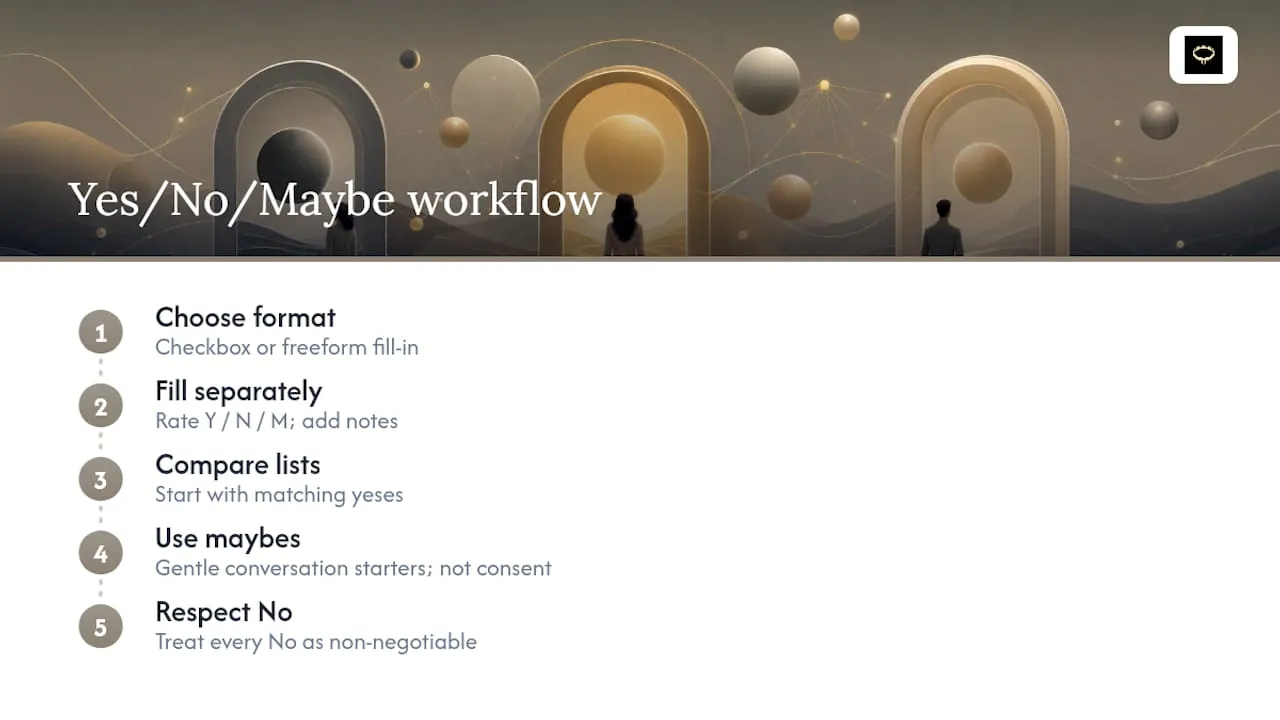
The recommended workflow is straightforward: fill separately, then compare. Start with matching yeses, because shared enthusiasm is the best foundation for any new exploration. Use maybes as gentle conversation starters, not as implied permission. Treat every no as non-negotiable. Some printable checklists also include codes for “fantasy only” and “N/A,” which is genuinely useful for separating what you’d like to do from what you’d only enjoy as a mental scenario.
Who actually benefits from using this checklist?
Long-term couples often discover the list surfaces preferences that never came up in years of conversation. New partners use it to establish a shared language before intimacy deepens. Solo users find it valuable for self-exploration, clarifying what they actually want before they’re in the moment. For kink and BDSM practitioners, a thorough yes/no/maybe checklist is close to a professional standard for scene preparation.
The concrete benefits are real. The format lowers embarrassment because you’re writing answers privately, not performing them in real time. It prevents assumptions, which are the source of most sexual miscommunication. It creates a shared vocabulary that both partners can reference later. And it surfaces discrepancies early, when they’re easier to discuss calmly.
One important limit: the list is a conversation starter, not a legal contract. Completing it together doesn’t replace ongoing, in-the-moment consent. Desires shift, moods change, and what felt like a yes last month may feel different today.
How to create a yes/no/maybe list you can actually use
A well-built list takes about 30 minutes to complete honestly. Here’s the process:
- Prepare your environment. Find a private, calm space with no time pressure. This isn’t a task to rush through.
- Choose your format. A checkbox template is faster; a freeform worksheet lets you add context. Pick whichever you’ll actually complete.
- Fill it privately. Clinicians and sex educators consistently recommend completing the list alone so your answers aren’t shaped by your partner’s reactions.
- Mark hard limits explicitly. These are non-negotiable. Label them clearly so they can’t be confused with soft maybes. If you need ideas, see our hard limits list with examples.
- Annotate your maybes. A maybe without context is almost useless. Note what conditions would make it a yes: timing, safewords required, physical considerations, or emotional state.
- Plan the comparison session. Agree on a time in advance, somewhere comfortable, with no other agenda competing for attention.
For labeling, a six-code system works well: Y (yes), N (no), M (maybe), IDK (genuinely unsure), F (fantasy only, not real life), N/A (not applicable to your body or situation). Consistent coding means your answers carry the same meaning when you compare them.
Pro Tip: Store your completed list somewhere private and encrypted, not in a shared notes app or an unlocked folder. If you’re using a digital tool, look for client-side encryption, meaning the platform itself can’t read your data.
How to share and negotiate the list with your partner
Sharing results works best in person, after both of you have filled the list separately. Sit down together, open both lists, and start with the items you both marked yes. That’s your shared foundation, and beginning there sets a genuinely positive tone before you get to anything complicated.
For maybes, use curious, neutral language rather than persuasive language. The goal is understanding, not convincing. Try: “You marked blindfolds as a maybe. What would make it feel comfortable, if anything?” rather than “Come on, blindfolds are harmless.”
That kind of framing keeps the conversation collaborative. It signals that you’re exploring together, not negotiating a transaction.
Before you act on anything from the list, run through a short safety checklist:
- Agree on a safeword system (a slow-down word and a full-stop word). Our list of safe word ideas can help you pick one.
- Confirm which items are hard limits for each person.
- Discuss aftercare: what each of you needs emotionally and physically after an intense experience.
- Agree on how to pause or stop mid-activity without it feeling like a failure.
Pro Tip: When a partner marks something as No, treat it as safety information, not rejection. Never ask for an explanation, and never return to the topic hoping the answer will change. If the no-holder wants to share their reasoning, that’s their choice to offer.
Digital reveal options exist too. Some couples prefer to share lists simultaneously via a shared document or a guided tool, which removes the awkwardness of one person watching the other read. A therapist-facilitated session is worth considering if the conversation feels emotionally loaded before it even starts.
Ready-made templates and where to download fillable checklists
Templates range from a one-page minimal checklist (good for new couples or first conversations) to exhaustive multi-page worksheets covering dozens of categories (better for experienced practitioners preparing detailed kink scenes). Start minimal if the topic is new; go detailed if you’re mapping complex preferences.
Here’s a sample set of items organized by category to give you a concrete starting point:
| Category | Sample items to rate Y / N / M |
|---|---|
| Sensual | Massage, kissing, body worship, blindfolds, feathers or ice |
| Communication | Dirty talk, praise, name-calling, being given orders |
| Restraint | Hand restraints, rope, being held down, spreader bars |
| Impact | Spanking by hand, paddles, floggers, marks that last a day |
| Power exchange | Obedience tasks, rules outside the bedroom, chastity, collaring |
| Psychological | Role play, humiliation, orgasm denial, tease and denial |
| Health and logistics | Barrier use, STI testing, alcohol before play (usually a no) |
Trusted sources for complete, downloadable checklists:
- Byrd / Inclusive Intimacy: A free fillable checklist designed for couples, individuals, and nonbinary readers; sexuality educators use it specifically because it lowers the barrier to starting difficult conversations.
- Sunny Megatron: Publishes Y/N/M resources oriented toward kink-positive and sex-positive communities, with more explicit kink categories than beginner lists.
- Bex Caputo (Superpowered Yes/No/Maybe list): An exhaustive worksheet with a wide range of kink and BDSM items, well-suited for experienced practitioners who want granular detail.
- FTLOI: Offers a fillable PDF format with clean layout, practical for digital completion and sharing.
Adapting the list for kink and BDSM scenes
In kink contexts, the difference between a hard limit, a soft limit, and a soft maybe is not semantic. It’s a safety distinction. A hard limit is an absolute no, never to be crossed regardless of context or how deep into a scene you are. A soft limit is something that might be possible under very specific, pre-agreed conditions. Skillfully Bound’s negotiation guidance makes the point clearly: soft limits deserve care and are not invitations to push.
Soft limits sit in “maybe, but probably not” territory. They require detailed negotiation and concrete conditions before anyone attempts them. That means specifying the exact context, the safeword in place, and what happens if the limit is reached mid-scene.
For safewords, a two-tier system is standard:
- Slow-down word (often “yellow”): signals discomfort or a need to check in without stopping the scene entirely.
- Full-stop word (often “red”): ends the scene immediately, no questions asked in the moment.
Aftercare planning belongs in the negotiation, not as an afterthought. Physical aftercare might include water, a blanket, or tending to any marks. Emotional aftercare varies more: some people need quiet closeness, others need verbal reassurance, and some need space. Agree on this before the scene, not after.
A practical negotiation script for a planned scene might open like this: “From our lists, we both said yes to restraint and spanking. Your maybe on floggers stays off tonight. Red stops everything, yellow means slow down and check in. Afterwards you want a blanket and quiet, and I’d like a text tomorrow.”
Deborah Kat’s BDSM negotiation checklist emphasizes that good negotiation also covers emotional intent: how do you want to feel after the scene ends? Framing it that way shifts the conversation from a list of permitted acts to a shared experience you’re both designing. If you want to write down what you agreed, a BDSM contract can hold the outcome of your list, but treat it as a reference, not a legal document.
If past trauma or abuse surfaces during negotiation, pause the exercise. Community resources like the Ripley Von Claws negotiation zine offer survivor-led perspectives. For professional support, a therapist specializing in sexuality or trauma is the right next step.
Common problems couples face with Y/N/M lists
Even well-intentioned conversations hit friction. Here are the most common pitfalls and how to handle them:
- One partner feels judged by the other’s responses. Normalize the fact that different answers are expected and healthy. The list reveals information; it doesn’t assign blame.
- Maybes become pressure. If one partner keeps returning to a maybe hoping it will shift to a yes, pause the conversation. A maybe is not a soft yes; it’s an open question that requires conditions, not persistence.
- One partner fills it to please the other. This is exactly why filling separately matters. If you suspect your partner marked things to match your preferences, revisit the list individually and compare again.
- Privacy concerns about storing the list. Paper is private by default. Digital lists need encryption. Never store sensitive answers in a shared or cloud-synced app without confirming the privacy settings.
- The conversation gets emotionally heavy. That’s a signal to pause, not push through. Agree to return to it another day, and consider whether a therapist or sex educator could help facilitate.
After your comparison conversation, a short debrief helps: what felt good about the discussion, what felt hard, and what you’ve agreed to explore next. Write it down somewhere private. It becomes the foundation for the next conversation.
Emotional readiness matters. If completing the list brings up significant distress, shame, or memories of past harm, that’s worth addressing with a professional before continuing. The list is a tool for connection, not a test to pass.
Keeping your list private, plus a digital option
Paper templates and free downloads work well for most people. Whatever you use, keep the completed list somewhere only you can open: paper in a drawer, or an encrypted file, not a shared cloud folder.
If you want to explore your answers solo before bringing them to a partner, Mistrix works along similar lines. Onboarding includes a fetish map, your hard limits and a safe word, and those are encrypted on your device with a key derived from your PIN, so the server stores only ciphertext it cannot read. For readers whose Y/N/M results point toward femdom or BDSM exploration, Mistrix’s AI Dominas can guide you through personalized sessions that respect exactly the limits you’ve set. The consent-first design principles behind the platform align directly with what this article covers.
Check Mistrix’s pricing tiers to see which plan fits your needs. The free tier is not a trial and needs no card.
This article is general information, not medical, legal, or therapeutic advice. For personal concerns around trauma, abuse, or sexual health, consult a qualified professional.
FAQ
What is a yes/no/maybe kink list?
A yes/no/maybe kink list is a private checklist where each person rates sexual activities or scenarios as yes (open to it), no (a firm boundary), or maybe (curious but needs negotiation). It’s used to map preferences and limits before exploring kink or BDSM with a partner.
What are some example questions on a yes/no/maybe list?
Items typically range from gentle activities like massage and role play to BDSM basics like restraint, impact play, and dominance/submission dynamics. Each item gets a Y, N, M, IDK, or F (fantasy only) rating so both partners can compare responses clearly.
What does “maybe” actually mean on the list?
Maybe signals curiosity or conditional openness, not consent. It means the activity needs further negotiation, specific conditions, or a safeword agreement before it can move forward.
What is the 3-3-3 rule for intimacy?
The 3-3-3 rule isn’t a standardized framework in sex education or clinical practice. Definitions vary across sources, and no single canonical version applies universally. If you’ve seen it referenced, check the specific source for that author’s definition.
How often should you update your yes/no/maybe list?
Sex educators recommend treating the list as a work in progress and revisiting it regularly, since desires and comfort levels change over time. Many couples review their lists after a significant new experience or at least once a year.