

Dom drop is the emotional and physical low a dominant or top can feel after an intense BDSM scene, often flatness, guilt, tiredness or withdrawal. It comes from the comedown after the adrenaline of play combined with setting down the responsibility of running the scene, and it usually passes within hours to a few days.
You are not broken, and you are not alone. Here is what to do right now:
- Ground yourself immediately. Sit or lie down, breathe slowly, drink water, and eat something small. Physical anchoring interrupts the freefall.
- Check in with your partner. Hearing that your submissive is safe, happy, and grateful is often the fastest relief for the guilt component of dom drop.
- Rest without judgment. Give yourself permission to feel flat or tired. The feeling is biological, not a verdict on your character.
Wiktionary defines dom drop as a state of low spirits experienced by a dominant after BDSM play. It is the counterpart of sub drop, and both deserve a place in your aftercare plan.
Key Takeaways
Dom drop is a real, biological experience that most dominants will encounter at some point, and it resolves within hours to a few days when met with grounding, partner reassurance, and basic self-care.
| Point | Details |
|---|---|
| Core definition | Dom drop is a neurochemical and psychological crash dominants experience after intense BDSM scenes. |
| Typical duration | Most cases resolve within hours to a few days; symptoms persisting beyond one week need professional attention. |
| Most effective immediate remedy | Partner confirmation that the submissive is safe and happy directly addresses the guilt component of dom drop. |
| Prevention starts before the scene | Agreeing on an explicit aftercare plan and pacing intensity reduces drop risk more than post-scene care alone. |
| Red flag threshold | Persistent low mood beyond one week, suicidal thoughts, or drop after every scene warrants kink-aware professional support. |
Table of Contents
- What does dom drop mean in the kink community?
- Why does dom drop happen? The neurochemistry explained
- Self-care strategies for dominants after a scene
- How to plan scenes to reduce dom drop risk
- When should you seek professional help?
- Related terms and community language
- Expert context and the limits of formal research
- Useful sources and further reading
- FAQ
What does dom drop mean in the kink community?
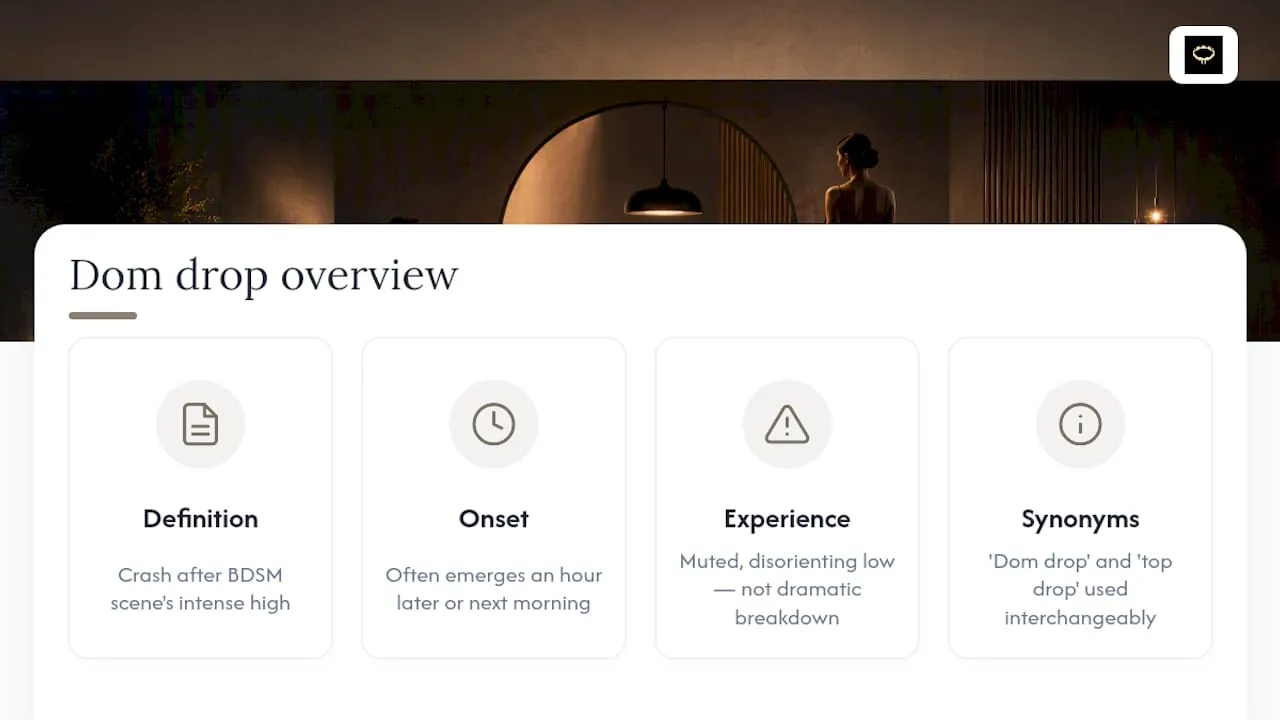
The term “dom drop” (also written “domdrop,” or called “top drop”) describes the crash that follows the intense physical and emotional high of running a BDSM scene. Community sources including Wiktionary list it alongside subdrop and top drop as accepted vocabulary in kink spaces, and the term has appeared in published literature archived at the Internet Archive, confirming it has been part of the written community record for years.
In practice, the experience tends to arrive quietly. A dominant who spent two hours holding total focus, reading their partner’s body language, managing intensity, and staying in control may feel perfectly fine immediately after the scene ends. Then, an hour later or the next morning, a strange flatness sets in. Nothing feels wrong, exactly, but nothing feels right either. That is the dom drop concept in its most common form: not a dramatic breakdown, but a muted, disorienting low that can catch even experienced Doms off guard.
The term “top drop” is used interchangeably in many communities, especially when the person running the scene does not identify as a dominant. “Post-coital dysphoria” is the clinical adjacent term for low mood following sexual activity, though it is broader and not specific to BDSM dynamics. For the purposes of this guide, dom drop and top drop refer to the same experience.
Why does dom drop happen? The neurochemistry explained
Dom drop has two distinct drivers, and understanding both helps you respond to it more effectively.
The first is the neurochemical crash. During an intense scene, your body floods with adrenaline, endorphins, dopamine, and oxytocin. These chemicals sustain focus, suppress pain, and create the heightened state that practitioners call “topspace”, the absorbed, almost meditative zone a dominant enters when fully in control. When the scene ends, those levels drop sharply. The result is a comedown that knki.fun’s aftercare guide describes as functionally similar to the crash after any intense physical or emotional exertion.
The second driver is what the community calls the responsibility load. Dominants carry the cognitive and emotional weight of the entire scene: monitoring consent signals, calibrating intensity, holding the submissive’s safety in mind at every moment. When that weight lifts at the end of the scene, the sudden absence can feel destabilizing. Waxplayme’s comparative analysis frames this as the dominance-specific component that separates dom drop from sub drop, the guilt and emptiness are not random; they are the psychological echo of a responsibility that has just been set down.
| Driver | Sub drop | Dom drop |
|---|---|---|
| Neurochemical crash | Endorphin/adrenaline drop after intense sensation | Same crash, often after sustained focus and control |
| Psychological trigger | Loss of the submissive state, vulnerability hangover | Release of the responsibility load, guilt loops |
| Typical emotional tone | Weepy, clingy, need for reassurance | Flat, guilty, withdrawn, replay loops |
| Physical presentation | Shaking, cold, fatigue | Fatigue, heaviness, low motivation |
| Visibility | Often visible and expressed | Often internalized and hidden |
Self-care strategies for dominants after a scene
Recovery starts with the body. Drink water before you do anything else. Eat something with protein and carbohydrates within an hour of the scene ending. The neurochemical crash is partly metabolic, and your body needs fuel to stabilize. Light movement, a short walk, gentle stretching, helps more than lying completely still, which can let the flatness settle deeper.

Once the physical basics are covered, the psychological work begins. Journaling is one of the most effective tools available, and it does not need to be elaborate. Three prompts that cut through guilt loops: What went well in that scene? / What did my partner express during and after? / What would I tell a friend who described this exact scene to me? That third prompt is the most powerful. Dominants are often far harsher judges of their own scenes than they would ever be of someone else’s.
Cognitive reframing matters here too. The guilt you feel after a scene is not evidence that something went wrong. Life Beyond Vanilla frames it clearly: the guilt is the comedown itself, a neurochemical artifact, not a moral signal. Treating it as information rather than verdict changes how you sit with it.
Short rest and self-care are enough for most dom drops. If you have eaten, slept, heard from your partner, and journaled, and the low mood is still present after 48 hours, bring your partner into the conversation. If it persists past a week or keeps recurring after every scene, that is when professional support becomes the right call.
How to plan scenes to reduce dom drop risk
Aftercare reduces the intensity of drop but does not guarantee prevention. The most effective prevention happens before the scene starts.
Pre-scene planning checklist:
- Agree on an explicit aftercare plan with your partner before the scene begins, not after. Who does what, and when?
- Set a realistic intensity ceiling. High-intensity scenes carry higher drop risk. Stagger intensity across sessions rather than escalating every time.
- Confirm safety signals and hard limits are current and mutual.
- Build in decompression time. Do not schedule a scene immediately before a demanding obligation.
- Discuss both partners’ aftercare needs openly. Dominants have needs too, and naming them in advance removes the awkwardness of asking mid-drop.
For high-intensity play specifically: plan a deliberate wind-down sequence within the scene itself, not just after it. Gradually reducing intensity in the final 15-20 minutes gives your neurochemistry time to begin stabilizing before the scene fully ends. You can also use our kink safety checklist as a pre-scene planning template, and our guide to writing a BDSM contract to formalize your aftercare agreement in writing.
Pro Tip: Add a post-scene aftercare assignment to your negotiation document: who initiates the 24-hour check-in, what form it takes, and what either partner should do if they are struggling. Written agreements remove the guesswork when one person is mid-drop and not thinking clearly.
When should you seek professional help?
Most dom drops are temporary and self-resolving. Some are not. Watch for these red flags:
- Low mood persisting beyond one week after a scene
- Suicidal thoughts or thoughts of self-harm (call or text 988, the Suicide and Crisis Lifeline, immediately)
- Severe functional impairment: unable to work, eat, or maintain basic routines
- Dom drop occurring after every scene, regardless of intensity or aftercare
- Escalating severity over time rather than stabilizing
If you recognize any of these, the right step is to contact a kink-aware therapist. Kink Aware maintains a directory of clinicians who understand BDSM dynamics and will not pathologize your practice. For trauma-informed context on how BDSM intersects with mental health, Mistrix’s guide on trauma-informed BDSM is a useful starting point before your first session with a clinician.
For immediate crisis support in the U.S.: call or text 988 (Suicide and Crisis Lifeline), or text HOME to 741741 (Crisis Text Line). Both are free, confidential, and available 24/7.
Related terms and community language
Understanding dom drop also means knowing the vocabulary around it, especially when negotiating aftercare or discussing experiences in community spaces.
- Top drop: used interchangeably with dom drop, particularly by people who top in scenes without identifying as dominants.
- Sub drop: the equivalent low on the submissive side, often more visible and more discussed.
- Topspace: the focused, absorbed state a dominant can enter while running a scene.
- Subspace: the floaty, altered state a submissive can enter during intense play.
- Aftercare: the care both partners give each other after a scene, physical and emotional.
- Post-coital dysphoria: low mood after sex in general, not specific to BDSM.
When naming your aftercare needs in a negotiation, be specific: “After intense scenes, I need verbal confirmation that you’re okay, and I’d like a check-in the next day.” Naming it removes the stigma and makes it a shared responsibility rather than a personal weakness. The Mistrix glossary covers these and related terms in more depth, and our guide to BDSM aftercare has examples for both roles.
Expert context and the limits of formal research
This guide draws on community sources, including Wiktionary’s lexicon entries and practitioner-written explainers from spaces like Life Beyond Vanilla and Spanksy.
It is worth being honest about the research landscape: formal clinical studies on dom drop specifically are limited. The neurochemical framework (adrenaline, endorphin, dopamine, and oxytocin shifts) is well-established in sports science and general psychology; its application to BDSM dynamics is largely community-derived and practitioner-observed rather than peer-reviewed. That does not make it less valid. It means you should treat the timelines and symptom descriptions here as informed community consensus, not clinical benchmarks, and consult a kink-aware professional when your experience falls outside the typical range.
This article is general information, not professional medical or psychological advice. For persistent symptoms or crisis situations, consult a qualified clinician or contact a crisis line.
Useful sources and further reading
The following resources are vetted for accuracy and relevance to dom drop and BDSM aftercare in the U.S. context:
If you are exploring the submissive side yourself, Mistrix’s AI Dominas lead written sessions that respect your hard limits, with a one-tap safe word. It is a companion for play, not a substitute for a partner’s aftercare or professional support.
FAQ
What is dom drop, and who experiences it?
Dom drop is a state of emotional and physical low that dominants and tops experience after an intense BDSM scene, caused by a neurochemical crash combined with the release of the psychological responsibility they held during the scene. Any person who runs a scene can experience it, regardless of experience level.
How do you give a dominant aftercare after a scene?
Offer explicit verbal confirmation that you felt safe and enjoyed the scene, bring water and a snack, ask whether they want physical closeness or space, and send a warm check-in message 18-24 hours later. Hearing that their partner is happy is often the fastest relief for the guilt component of dom drop.
What are the symptoms of sub drop, and how do they differ from dom drop?
Sub drop typically presents as visible distress: shaking, tearfulness, clinginess, and a strong need for reassurance. Dom drop tends to be quieter, showing up as flatness, guilt, replay loops, and withdrawal rather than overt emotional expression.
What is sub drop in a relationship context?
Sub drop is the emotional and physical crash a submissive experiences after a BDSM scene, driven by the same neurochemical comedown as dom drop but shaped by the vulnerability and intensity of the submissive role. Both partners may experience drop after the same scene, which is why aftercare for both roles matters.
Can dom drop be prevented entirely?
Aftercare reduces the intensity and duration of drop but does not guarantee prevention. The most effective risk-reduction steps are pre-scene: agreeing on an explicit aftercare plan, pacing intensity, and building in decompression time before the scene ends.