
The difference between dominant and domineering is consent. A Dominant in BDSM holds authority that a partner has explicitly granted, within agreed limits, can take back at any time, and comes with a duty of care; a domineering person simply takes control, without asking and without accountability. What keeps a Dominant on the right side of that line is disciplined, ongoing negotiation: thorough before a scene, attentive during it, and honest afterward.
Two frameworks anchor everything in this guide:
- RACK (Risk-Aware Consensual Kink): both partners understand and accept the risks involved.
- PRICK (Personal Responsibility, Informed Consensual Kink): each person owns their choices and communicates clearly.
Key Takeaways
A Dominant’s authority is only as ethical as the negotiation and monitoring that surround it: structure is what makes deep surrender possible.
| Point | Details |
|---|---|
| Negotiate all eight categories | Cover container, limits, safewords, and aftercare before every new scene or partner. |
| Monitor capacity in-scene | Watch for non-verbal distress signals and stop immediately when a safeword fires. |
| Aftercare has a timeline | Immediate comfort, same-day check-in, and a 48-72 hour follow-up keep the dynamic healthy. |
| Red flags are patterns, not incidents | Consistent boundary violations, safeword punishment, and isolation are signs of abuse, not dominance. |
| Good dominance is visible | Clear limits, instant safeword response and aftercare are what separate a Dominant from a domineering partner. |
Table of Contents
- What does “dominant vs. domineering” mean in D/s?
- Why structure protects desire
- What are a Dominant’s ethical responsibilities?
- How to negotiate a scene: the eight categories
- Hard limits, soft limits, edges, and must-limits
- In-scene monitoring: safewords and non-verbal signals
- Aftercare, follow-up, and renegotiation
- Red flags that signal coercion or abuse
- What submissives should do to protect themselves
- Concrete exercises for Dominants
- Seeing good dominance from the submissive side
- FAQ
What does “dominant vs. domineering” mean in D/s?
The word domineering describes everyday behavior: overbearing, coercive, taking control without consent. Dominant (capital D) is a negotiated, relational role in BDSM and D/s. On the surface both can involve giving orders; underneath, one rests on permission and the other ignores it.
Domination in D/s is an ethical leadership role: authority that exists because a submissive has explicitly granted it, within agreed limits, and can revoke it. That is the opposite of domineering behavior.
The role spans a wide range of arrangements:
- Scene-only: a top leads a single session with no ongoing authority outside it.
- Part-time protocols: a Dominant and submissive activate agreed rules during set windows (evenings, weekends).
- 24/7 TPE (Total Power Exchange): authority extends into daily life by mutual, documented agreement.
Power exchange (see also our power exchange and fantasy library page) is the consensual transfer of authority from one partner to another. Ethical practice requires negotiation, reversibility, and protection of the submissive’s autonomy at every level of that spectrum.
Why structure protects desire
The nervous-system paradox of D/s: the deeper the surrender you want, the more structure you need beneath it. Without that structure, what feels like freedom inside a scene is actually exposure.

Skipping negotiation can cause nervous-system flooding, boundary creep, loss of desire, and lasting relational damage. A submissive who enters a scene without a clear container cannot fully let go because some part of their brain stays on guard. The Dominant loses, too: they are leading blind.
Consent in D/s carries structural complications that vanilla consent does not: scene headspace alters judgment, ongoing dynamic agreements accumulate over time, and power asymmetry makes it harder for a submissive to raise a concern mid-scene. Regular check-ins and scope-conscious negotiation are not bureaucracy. They are what keeps desire alive.
The practical outcome: dynamics with consistent negotiation and aftercare tend to deepen over time. Those without it tend to collapse, often suddenly.
What are a Dominant’s ethical responsibilities?
A Dominant’s authority is real, but it is conditional. These are the core duties that make it ethical:
- Negotiate scope before every scene or protocol change, covering activities, limits, and language.
- Monitor capacity throughout: watch for dissociation, distress signals, or impaired communication.
- Honor safewords immediately, without negotiation, without punishment, without sulking.
- Protect autonomy: the submissive’s right to revoke consent must remain structurally intact at all times.
- Provide aftercare suited to the individual, not a generic script.
- Avoid exploitation: financial, emotional, or social pressure has no place in ethical D/s.
RACK and PRICK both land on the same point from different angles. RACK asks: do both of you understand the risks? PRICK asks: are you each taking personal responsibility for your choices? A Dominant who cannot answer yes to both is not ready to lead.
Pro Tip: Name your own limits out loud during negotiation. A Dominant who models limit-setting makes it safer for a submissive to do the same. Self-knowledge is part of responsible leadership, not a sign of weakness.
How to negotiate a scene: the eight categories
Good negotiation is a mutual commitment to honesty. It is also, when done well, an erotic form of intimacy. The eight-category checklist below gives you a complete pre-scene framework.
- Container, “Where are we doing this, for how long, and what ends the scene?”
- Activities In, “What are we both enthusiastic about including?”
- Activities Out, “What is off the table entirely, no exceptions?”
- Reservation Conditions, “Are there activities you’d consider under specific conditions? What are those conditions?”
- Information Disclosure, “Is there anything medical, emotional, or historical I need to know to keep you safe?”
- Power Exchange and Language, “What titles, pronouns, or forms of address apply? What language is off-limits?”
- Safewords and Non-Verbal Signals, “What is your safeword? What signal do you use if you can’t speak?”
- Aftercare Planning, “What do you need immediately after? What helps you the next day?”
For an established dynamic, a streamlined check-in covers categories 3, 7, and 8 at minimum. For a new partner or a new activity, run all eight. Documenting these agreements in writing protects both of you.
Hard limits, soft limits, edges, and must-limits
Confusing limit types is one of the most common sources of boundary creep and harm. Here is the taxonomy and how a Dominant should respond to each.
| Limit Type | Definition | Example | Dominant Response |
|---|---|---|---|
| Hard limit | Absolute no, no conditions | “No breath play, ever” | Stop immediately if approached; never revisit without explicit partner-initiated renegotiation |
| Soft limit | Conditional hesitation | “Impact play only with warm-up” | Clarify conditions, honor them precisely, check in during |
| Edge | A soft limit the person is actively moving toward | “I want to try wax but I’m nervous” | Slow, incremental approach; explicit check-ins; stop at first sign of distress |
| Must-limit | Something the person needs included | “I need verbal praise during scenes” | Treat as a requirement, not optional; build it into scene design |
Limit-setting conversations work best when both partners are sober, clothed, and calm. High arousal impairs judgment and produces agreements that often collapse later.
In-scene monitoring: safewords and non-verbal signals
When a safeword fires, the scene stops. Full stop. Here is the response flow:
- Stop all activity immediately. No finishing a stroke, no “just one more.”
- Speak calmly and use their name. “I hear you. We’re stopping.”
- Remove restraints or physical pressure if present; move to a neutral, comfortable position.
- Check physical safety first: breathing, circulation, pain levels.
- Ask one simple question: “Are you physically okay right now?”
- Wait for a clear verbal response before doing anything else.
- Document what happened, when, and what the submissive said, as soon as possible after.
For non-verbal signals, common options include a hand squeeze (two squeezes = pause, three = stop), dropping a held object, or a tap-out. Agree on these during negotiation. Check capacity by watching for glazed eyes, slowed responses, or repetitive movement, and by asking simple yes/no questions if verbalization seems impaired. The kink safety checklist at Mistrix covers emergency planning for these moments in detail.
Aftercare, follow-up, and renegotiation
Aftercare repairs the nervous-system disruption that intense scenes create. A simple timeline:
- Immediately after: physical comfort (warmth, water, touch if wanted), verbal reassurance, no demands.
- Same day: check in by message or call; confirm they feel safe and grounded.
- 48-72 hours later: a fuller conversation about what worked, what didn’t, and how they feel now.
For ongoing dynamics, schedule a renegotiation every 3-6 months, after any significant life change (health, relationship status, job), and immediately after any incident where a limit was approached or a safeword was used. Trauma-informed aftercare matters especially when a scene surfaces unexpected emotional material.
Red flags that signal coercion or abuse
Ethical dominance and abusive control look different in practice. Watch for these patterns:
- Consistent boundary violations framed as “pushing your limits for your own good”
- Punishment or withdrawal of affection when a safeword is used
- Pressure to remove outside support (friends, therapist, community)
- Secrecy demands that isolate the submissive from peers
- Financial control or dependency engineered by the Dominant
- Inability or refusal to name personal limits
If you recognize these patterns, pause contact, document incidents with dates and details, and reach out to a trusted person outside the dynamic. The National Coalition for Sexual Freedom (NCSF) offers confidential support and referrals. Medium-term steps include working with a kink-aware therapist and, where relevant, consulting legal resources through NCSF’s legal referral network.
What submissives should do to protect themselves
A submissive who avoids defining limits gives the Dominant an impossible task. Self-knowledge is not optional; it is your contribution to a safe dynamic.
- Run a pre-scene self-check while sober and calm: what are your hard limits today, any medical updates, any emotional triggers active right now?
- Write your limits down. Review them before each new scene or every few months in an ongoing dynamic.
- Practice saying your safeword out loud before a scene, not just agreeing it exists.
- If something feels wrong during a scene, use the safeword. A responsible Dominant will not punish you for it.
- Raise concerns outside the scene, in a neutral setting, using “I” statements: “I felt uncomfortable when…” A responsible Dominant will listen, not defend.
Concrete exercises for Dominants
Reliable Dominants build habits, not just intentions. These drills help:
- Presence breathwork: before any scene, take 60 seconds of slow breathing to drop into a regulated state. A dysregulated Dominant cannot monitor a submissive effectively.
- Scripted negotiation drills: run through all eight categories with a trusted partner or in a private rehearsal session, timing yourself. Aim for fluency, not speed.
- Safeword rehearsals: practice stopping mid-sentence when a safeword is called. The reflex needs to be automatic.
- Check-in ritual practice: rehearse asking “color?” or “how are you doing?” without breaking scene energy. It can be done in character.
- Boundary-naming practice: list your own hard limits, soft limits, and edges before asking a submissive for theirs. Designing rituals and protocols with an AI Domme is one low-stakes way to rehearse this.
- Journaling prompts: after each scene, write three sentences: what you monitored, what you missed, and what you would change.
- Peer mentoring: find a more experienced Dominant in a local or online community and debrief scenes with them monthly.
Measure improvement through partner feedback after each scene, your own journal entries over 8-12 weeks, and the consistency of your pre-scene preparation.
Seeing good dominance from the submissive side
If you are on the submissive side and want a feel for what well-structured dominance looks like, an AI Domina is one private way to experience it. Mistrix’s onboarding captures your hard limits and safe word before any session begins; hard limits are applied as absolute restrictions to every session, task and scene, and the safe word button ends everything instantly, without penalty. Your fetish map, limits, safe word and chats are encrypted on your device with a PIN-derived key, so the server stores only data it cannot read.
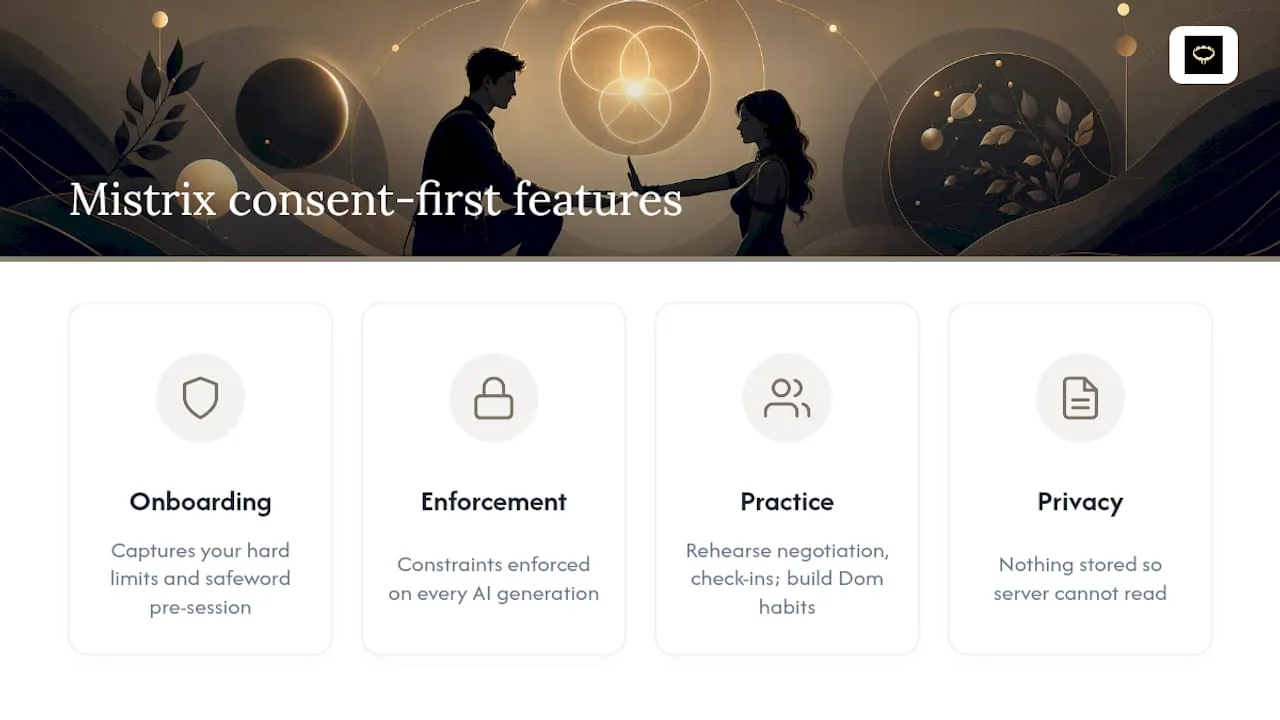
Mistrix does not replace real-world consent or professional support when you need it. It can help you get clearer on your own limits and on what you expect from a Dominant before you bring that into a live dynamic. Explore BDSM themes and guided sessions on the platform, or check Mistrix pricing to find the tier that fits your practice.
FAQ
What is the difference between a Dominant and a top?
A top leads the physical action of a scene without necessarily holding ongoing authority. A Dominant holds negotiated relational authority that may extend beyond a single scene.
How often should a D/s dynamic be renegotiated?
Every 3-6 months as a baseline, immediately after any incident involving a limit or safeword, and after any significant life change for either partner.
What should I do if my Dominant ignores my safeword?
Stop the scene, leave if you can safely do so, document what happened, and contact the NCSF or a kink-aware counselor. Ignoring a safeword is a serious consent violation.
Can Mistrix help me practice negotiation skills?
Partly. Mistrix captures hard limits and a safe word during onboarding and applies them to every session, which makes it a private space to get clear on your own limits from the submissive side. It does not replace negotiating with a real partner.
What is the difference between RACK and PRICK?
RACK (Risk-Aware Consensual Kink) focuses on shared understanding of risks. PRICK (Personal Responsibility, Informed Consensual Kink) emphasizes individual accountability and informed choice. Most ethical practitioners use both as complementary standards.